Tuesday, November 8, 2011

Asteroid 2005 YU55 Gets Closer to Earth; “No Chance of an Impact”

Written by Jason Major


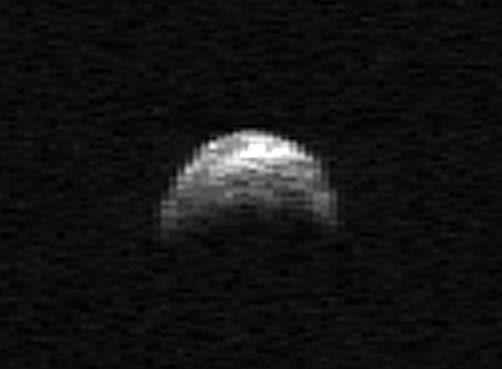
Yes, it's coming. Yes, it's big. Yes, it will be even closer than the Moon. And yes... we're completely safe. YU55, acquired in April 2010. Credit: NASA/Cornell/Arecibo.


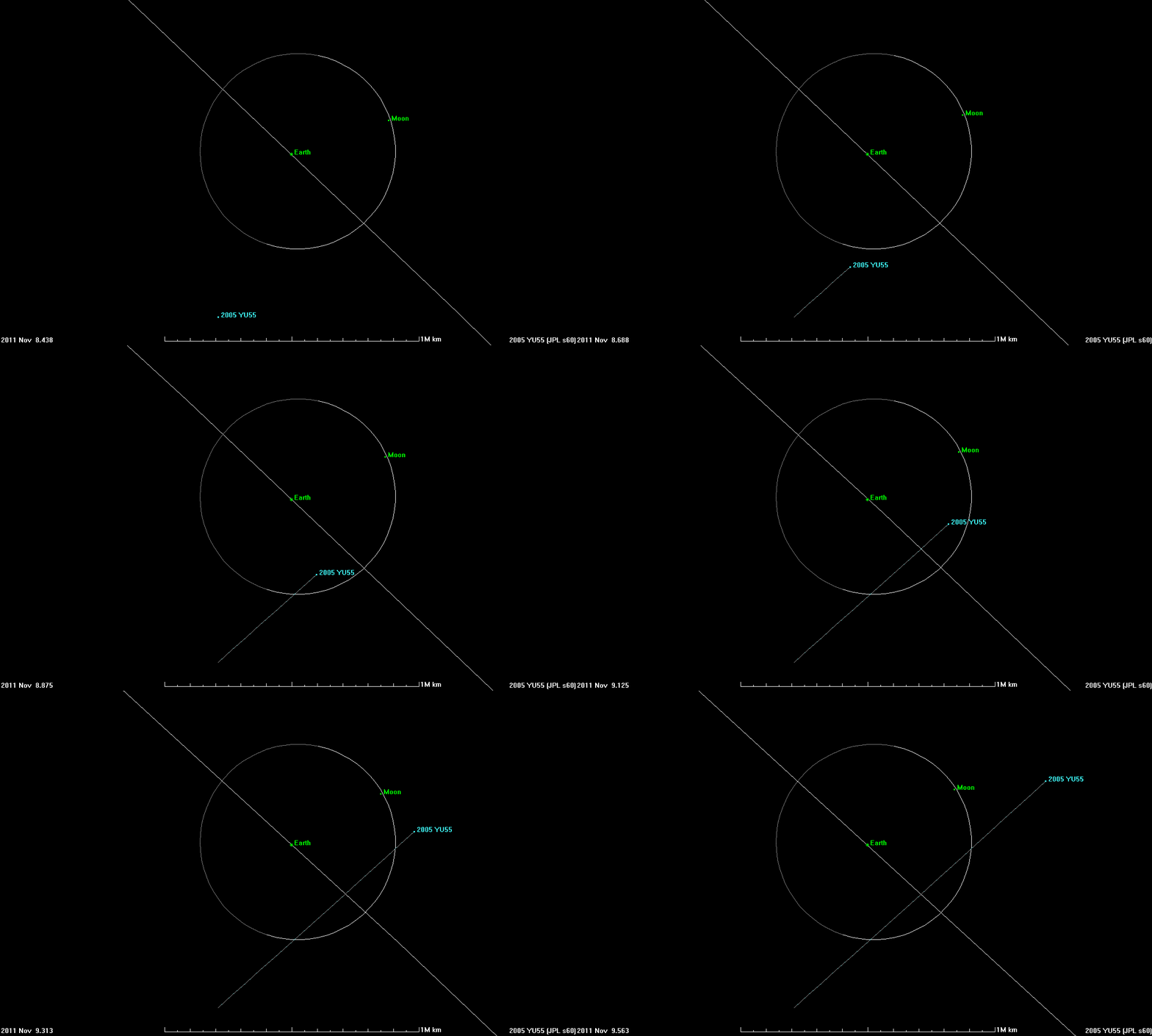
The 400-meter-wide asteroid 2005 YU55 is currently zipping through the inner Solar System at over 13 km (8 miles) a second. On Tuesday, November 8, at 6:28 p.m. EST, it will pass Earth, coming within 325,000 km (202,000 miles). This is indeed within the Moon's orbit (although YU55's trajectory puts it a bit above the exact plane of the Earth-Moon alignment.) Still, it is the closest pass by such a large object since 1976... yet, NASA scientists aren't concerned. Why?

Because its orbit has been well studied, there's nothing in its way, and frankly there's simply nothing it will do to affect Earth.


Period.

2005 YU55's miniscule gravity will not cause earthquakes. It has no magnetic field. It will not strike another object, or the Moon, or the Earth. It will not come into contact with cometary debris, Elenin, a black dwarf, Planet X, or Nibiru. (Not that those last three even exist.) No, YU55 will do exactly what it's doing right now: passing through the Solar System. It will come, it will go, and hopefully NASA scientists – as well as many amateur astronomers worldwide – will have a chance to get a good look at it as it passes.

Scientists with NASA’s Near-Earth Objects Observation Program will begin tracking YU55 on Friday, November 4 using the 70-meter radar telescope at the Deep Space Network in Goldstone, California , as well as with the Arecibo Planetary Radar Facility in Puerto Rico beginning November 8. These facilities will continue to track it until the 10th.

This close pass will offer a great opportunity to get detailed radar imaging of YU55, an ancient C-type asteroid literally darker than coal. Since these objects can be difficult to observe using visible light, radar mapping can better reveal details about their surface and composition.

To help inform the public about YU55 NASA's Jet Propulsion Laboratory in Pasadena recently hosted a live Q&A session on Ustream featuring specialists Marina Brozovic, a Goldstone Radar Team scientist, and Don Yeomans, manager of NASA’s Near-Earth Object Program. They fielded questions sent in via chat and Twitter... a recording of the event in its entirety can be seen below:


Video streaming by Ustream

Undoubtedly there will still be those who continue to spread misinformation about 2005 YU55. After all, they did the same with the now-disintegrated comet Elenin. But the truth is out there... and the truth is that there's no danger, no cover-ups, no "plots", and simply no cause for concern.

"It's completely safe... no chance of an impact."

– Don Yeomans, JPL


Read more about YU55 on our previous post or  on NASA's Near-Earth Object Program site.

UPDATE: JPL has released a brief video about YU55 featuring research scientist Lance Benner, who specializes in radar imaging of near-Earth objects:


Although classified as a potentially hazardous object, 2005 YU55 poses no threat of an Earth collision over at least the next 100 years. However, this will be the closest approach to date by an object this large that we know about in advance and an event of this type will not happen again until 2028 when asteroid (153814) 2001 WN5 will pass to within 0.6 lunar distances. – Near-Earth Object Program, JPL

Monday, November 7, 2011

Product Review: The Celestron SkyScout Personal Planetarium

Written by Tammy Plotner

My initial reaction to the Celestron SkyScout was why in heaven – and on Earth – would someone want a personal planetarium when they have the real deal at their disposal? Like most folks my age, I can’t resist new technology and the more I read and heard about what the Celestron Sky Scout could do, the more I wanted to examine one. Could a little piece of equipment provide as much information, knowledge and entertainment as a live astronomer? Could an electronic box take the place of a book? But most of all… What can the Celestron SkyScout Personal Planetarium really do?
Celestron SkyScout Personal Planetarium

When I saw the Celestron SkyScout in person, the young man who let me examine it told me, “Ma’am? You’d be much better off getting a book of star charts or finding someone to teach you about the stars.” Ultimately, I love it when someone doesn’t recognize me or simply sees the blond hair and doesn’t think there’s much going on underneath it. Although a secret part of me agreed with him, I simply flashed him my best vacant smile and gave him the line that all of us techno geeks use when we’re caught out buying a new toy… “It’s a present.”

Grinning wickedly, I snatched the box from him and hurried off where I could examine the SkyScout in private. On the way, I picked up a jumbo package of batteries and sat down to see how much of its operation was intuitive and how often I’d have to refer to the instructions. Surprisingly enough, anyone who has mastered an iPod and has at least a passing knowledge of the written English language would be well on their way to using a Celestron SkyScout. My second point of curiosity was its resemblance to a digital camcorder… Another techno-gadget I’m familiar with. After a quick consultation with the instructions, all I needed was dark.

Personal Planetarium? Snort. Show me what you can do…

Turn it on and GPS technology takes over. Within minutes, the Celestron Sky Scout had pinpointed my location on Earth and was aware of every movement in right ascension and declination of the unit. It knew where I was at, and it knew where it was pointed. Aiming the Celestron SkyScout is precisely like using a camcorder. Inside of its viewfinder you’ll see a red “bullseye” that’s adjustable in brightness so it doesn’t overpower dimmer stars. When you get the object you’re aiming at centered, you just push a button on top and it fixes the position and displays a screen of options as to what you’re looking at. Well, duh! I know it’s Mars… But when the soothing, melodic female voice started whispering stories in my ear? I knew I was hooked.

Needless to say, I took off on my own tour of the heavens with the Celestron SkyScout, happily eating up all of the information it gave me. Not all things have audio to accompany them, only 200. But, for many of us having RA, Dec, magnitudes and more at the push of a button is simply the cat’s asteroid. While you’ll never visually see all 6000 objects the Celestron SkyScout is capable of, what matters most is that it’s in there… And just waiting on you to release it.
Celestron SkyScout

Next up? Show me tonight’s “Must See” list. With the cool, calculated precision that only a data base could deliver, the Celestron SkyScout Personal Planetarium gave me a tour that even I would have been proud of. It virtually walked me star by star through constellation lessons that impressed even me. What’s best? I know that it can also tell me when the ISS is passing by or where the latest comet is located. How many friends can you carry around in a backpack that can tell you that? True. These are all things I know, things I present in astronomy outreach programs, but the Celestron SkyScout is much more than that.

For seasoned astronomers? Don’t laugh the Celestron SkyScout off. Instead, tell me how many times you’ve had difficulty distinguishing Pi and Xi Draconis from background stars. If you’re a star hopper, what would you give if you could just point a little box at the star in question and have it immediately tell you that it is indeed Delta Librae you’re aimed at and you’re ready to head to your charts? Ah… You’re getting the real picture now, aren’t you?!

But, I told you these Celestron SkyScout Personal Planetarium thingies were a lot more didn’t I? Yes. And I meant it. My teenage son once enjoyed telescoping with me, but there came an age when it simply wasn’t “cool” to be seen with Mom, and I understood. Yet, when I handed him the SkyScout, he and his girlfriend took off in the dark together and had a wonderful astronomy experience alone that I couldn’t give them. At star parties, I’ve handed the Celestron SkyScout to people that I knew were too afraid to ask questions… and hours later they’d hand it back with the most wonderful smiles on their faces. They’d tell me how much they enjoyed using it and how much they learned. Even the most hard-core astronomers I know have found something undeniably “cool” about this gadget.

Celestron SkyScout Personal Planetarium


So why the Celestron SkyScout Personal Planetarium and not some other type of electronic gadget that displays the night sky? Reality check. I use the astronomy equipment I buy and I use it hard. I buy the brands I want and I put them to the test. Over the years I’ve dropped, I’ve kicked, I’ve banged, I’ve slammed, I’ve traveled, I’ve shared, I’ve abused and I have absolutely loved and appreciated the long term durability and quality of Celestron products. Why should the Celestron SkyScout be any different? Eight months and countless hands later…

It’s still on the original batteries.

The Celestron SkyScout has the ability to have a green laser attached to it and external speakers so it can do a “show and tell” program for large groups... even a free download which will allow you to change languages! But the most awesome feature of all is the Celestron SkyScout really will put the Universe in your hands.

Why wait to order one for yourself or a family member? OPT has the Celestron SkyScout in stock now!

Product Spotlight: The Orion SteadyPix iPhone Adapter

Written by Tammy Plotner

Are you ready for a really cool, new product? Then you've got to check out the Orion SteadyPix iPhone Adapter! This dandy little piece of equipment is a felt-lined clamp which attaches right to any 1.25" eyepiece (and barrels up to 1.5") and works with the original iPhone, iPhone 3, 3GS, 4 or iPhone 4S. The bracket holds the iPhone camera lens directly over the "sweet spot" of your telescope's eyepiece and allows you to take great pictures of things like bright deep sky objects, the planets, the Moon and sunspots. Now you don't have to be a professional, or have a lot of expensive equipment to do some astrophotography!

Orion SteadyPix Telescope Afocal Adapter for iPhone


The Orion SteadyPix Telescope iPhone Afocal Adapter even lets you display a live view of the image projected by your telescope on your iPhone screen so it acts like a "real time" monitor. This is a great idea for those who like to share the view with family and friends. The monitor mode is also great for outreach and allowing those with mobility issues to easily see what the telescope sees. What's more, the SteadyPix iPhone Adapter can even let you attach your iPhone to a photo tripod for wide-field pictures without a telescope.

Be the first kid on your block to have the Orion SteadyPix iPhone Adapter! Order yours at OPT today!

Friday, November 4, 2011

Weekend SkyWatcher's Forecast - November 5-6

Written by Tammy Plotner

Greetings, fellow SkyWatchers! With a lovely gibbous Moon taking over the sky, now is the time to really enjoy some "high power" observations. Are you ready? Then let's take a look at what's happening this weekend...


Saturday, November 5 - Today in 1906, a man named Fred Whipple was born. If that name doesn’t ring a bell for you – it should. Thanks to Dr. Whipple’s work we have a clearer understanding of the orbital mechanics of comets and their relation to meteoroid streams. Not only that, but he founded the SAO observatory in Arizona, discovered six comets, made invaluable contributions to research in the upper atmosphere, and was the first to call a comet a “dirty snowball.” His guess about the outgassing properties of comets was proved true when the first flyby of Comet Halley was made!

To honor Dr. Whipple a bit, let’s have a look at a beautiful optical pair/multiple system as we journey to the southernmost star in the “Circlet” – Kappa Piscium (RA 23 26 55.9553 - Dec +1 15 20.189) - the "k" symbol on our map.

Easily split in even binoculars, this lovely green and violet combination of stars may have once belonged to the Pleiades group. 5th magnitude Kappa is a chromium star – one with unusual spectral iron properties – which rotates completely in around 48 hours. It shows lines of uranium, and the possibility of a very rare element known as holmium. Both the uranium and osmium content could be the result of a supernova explosion in a nearby star. Enjoy this colorful pair tonight!

Now aim binoculars towards Gamma – the “Y” symbol on our chart. Gamma is a yellow-orange giant star located about 130 light years distant. Oddly enough for a giant, it only puts out about 61 times more light than our Sun – but with good reason… it’s currently fusing it’s core to carbon. Right now, it is waiting to become a white dwarf, but that’s not what distinguishes Gamma – it is its speed. Apparently Gamma came from outside our Milky Way Galaxy altogether! According to its low metal content and cyanogen-weak spectral signature, Gamma had to have originated outside the galactic disc and it is still traversing the sky at over three-quarters of a second of arc per year!


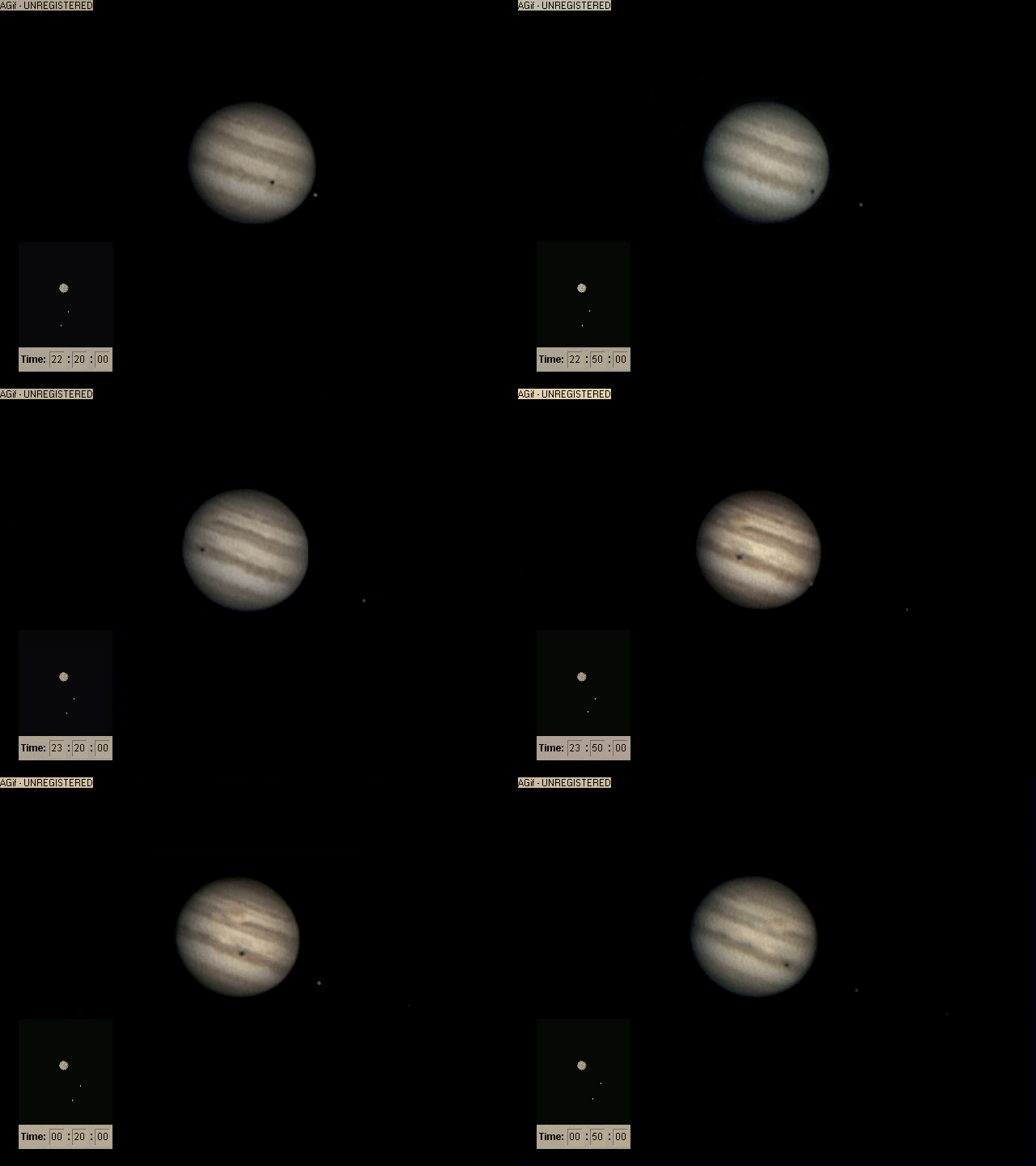
Sunday, November 6 - "Now that she's back in the atmosphere, with drops of Jupiter in her hair..." Oh! Hey, there! Come on over and have a seat. Yeah, I really like that "Train" song, too. While the Moon is putting the brakes on deep sky observing, why don't you take a look though the magnificent eye of the 9" TMB refractor of Dietmar Hager and we world-wide friends can spend a little quality time together with Jupiter. (For a 3D impression, just look at the above image and cross your eyes. Focus on the image you'll see in the center... and you'll see 3D!)

Here... You look through the eyepiece of a little telescope for awhile and I'll tell you some of the things we know about this giant planet.

What's that you say? Yes. Jupiter is big... Big enough to hold the mass of 1,000 Earths and about 1/10 the size of our Sun. Its a heavy-weight, too... But, believe it or not, Jupiter's density is only about 1/4 of that of Earth's. Scientists think this means the giant planet consists mostly of hydrogen and helium around a core of heavy elements. That means Jupiter more closely resembles a sun instead of a planet! Yeah... It's hot there, too. As a matter of fact, Jupiter is putting out twice as much heat as it receives from Sol. Near the core temperature may be about 43,000 degrees F (24,000 degrees C)... Even hotter than the surface of the Sun. Hot enough to get a burn? Darn right. Those subtle tones of red and brown are chemical reactions much like what happens when we humans get a sunburn.


I see you smiling in the dark. Are you starting to notice details Jupiter's cloud bands? Even a small telescope shows these areas called "zones". This is where chemicals have formed colorful layers of clouds at different heights. The white belts are made of crystals of frozen ammonia and they are positioned much higher than the dark belts. Of course, you know all about the "Great Red Spot", but sometimes it's pretty hard to see unless you know when to look. Jupiter makes a complete rotation in about 10 hours, so even if you can't see something right now - you can wait awhile and it will come around.

Speaking of coming around, did you notice how close one of Jupiter's moon is getting to the edge of the planet? Then keep watching because we're about to see a transit happen. Jupiter has at least 60 moons, but 4 of them are bright and very easy to see even in binoculars. They were discovered by Galileo, and that's why you'll sometimes hear them called the "galiean moons". When they zip around behind Jupiter in their orbit, it's called a occultation - but when they go in front of the planet from our point of view, it's called a transit. The really fun part is that you can not only see the little moon going across the surface, but a few minutes later? You can see the shadow, too! Here's a little bit of magic from another friend of ours named Sander Klieverik.


Click on image to open a new window and start animation.


Isn't that just the coolest? You're going to be hearing a lot about Sander's work here in the near future. In the meantime, why don't you keep practicing timing galiean events and seeing them? Here's a handy Jupiter Moon Tool, and Sander has also prepared a Jupiter Almanac as well!

"But tell me, did the wind sweep you off your feet? Did you finally get the chance to dance along the light of day... And head back to the Milky Way? And tell me, did Venus blow your mind? Was it everything you wanted to find? And did you miss me while you were looking for yourself out there?"

Now, quit bogarting that eyepiece... It's my turn!

Many thanks to the one and only Dietmar Hager, Jupiter Video courtesy of Northern Galactic and the up and coming Sander Klieverik's "AstronomyLive". Song lyrics - "Drops of Jupiter" are from the artist "Train" and thanks to Universe Today. Let's keep on rockin' the night!

Tuesday, October 25, 2011

The Galileoscope – Hands-On Learning For All Ages


For many of us, the northern nights are getting longer and our minds and hands need something to keep them occupied. Star parties and public education nights are becoming fewer, but school is back in session and so is the opportunity to teach. In the south, warmer nights are coming up and so is the chance to share your knowledge of the skies and astronomy equipment with friends and family. It's just the right time of year to take a close look at a telescope that really serves a purpose - the Galileoscope.

My first experience with the Galileoscope was during the 2009 "Year Of Astronomy". I purchased one to be used in conjunction with outreach programs that dealt with history. Nothing more. Nothing less. In other words, I struggled to put the thing together, used it once or twice, and pretty much put it back in the box and put it away. I was too "busy" to really pay too much attention to it.

And that was a real shame on my part.

A couple of months ago it came to my attention that the Galileoscope was now readily available. When it first came out, it was a long waiting list - but not anymore. Now these basic replica telescope kits can be purchased by the case and be in your hands within weeks. Just seeing this advertisement was enough to motivate me to go on a search mission in my astronomy "stuff" and re-locate my own. A few boxes here, a couple of shuffles there and next thing you know, there it is. Still assembled and still in perfect condition. Now I didn't need to be afraid of it. If something happened? Hey! It could be replaced.

With the instructions missing from the box, the next step was to find out some very pertinent information - and personal thoughts - that I couldn't find on-line. Time to contact one of the Galilescope's designers, Rick Fienberg. As former Editor in Chief of Sky & Telescope magazine, he's an expert on astronomy education and popularization and is intimately familiar with the amateur-astronomy community, a critical component in the success of the Galileoscope... and a really nice guy, besides. What I needed to know was if it could be repeatedly assembled and disassembled without ruining it. After all, just one blown O-ring brought down a shuttle...

"The Galileoscope is designed to be disassembled and reassembled repeatedly. This feature is essential for a product intended (at least in part) for classroom use -- schools with limited funds are able to buy only a small supply of Galileoscopes and have to use them over and over again rather than let students take them home to keep." said Dr. Fienberg. "We always hoped that the Galileoscope wouldn’t end up as a one-shot, short-term product that would die at the end of IYA2009. We created something that simply didn’t exist before and for which there is a huge education-and-outreach need. The need remains, and the Galileoscope continues to fulfill it."

Feeling the outreach fire beginning to burn again, I carefully laid the scope out on the table and began the process of reverse engineering. Once apart, I walked away for awhile and came back nervous. However, I didn't need to be. All I needed to do was go over the Galileoscope Assembly Instructions and watch the Galileoscope Assembly Video. What I found this time wasn't what I was expecting. My first experience with the scope was hurry up, get it done, get it to a program... and not really use it. This time was different. This time I was really looking at the optics, understanding how to explain how they worked and impressed with the simplicity and quality of the kit as a whole. It made me think... Just as it made the people who designed it think.

"Advice on the design of the telescope came from a variety of people not connected with the project. Optical designers, amateur and professional astronomers, and educational developers all provided input on what makes an effective, yet inexpensive telescope kit. It was critical that the telescope kit be educationally useful as well as astronomically useful. Thus great consideration was given as to how the educational uses of the telescope could be maximized. However, before we embarked on a new telescope design we needed to understand the limitations of previous inexpensive telescopes." explains Fienberg. "The key optical requirements of the Galileoscope centered on usability and image quality. Since price was clearly going to be an issue, we needed a trim, justifiable set of requirements. The key imaging requirement was to be able to to create a “Wow” experience for kids, from nearly any location in the world."

While the Galileoscope team's original "Wow" intentions were meant to be visual - and meant for a younger audience - the real "Wow" happened for me when I realized exactly what I was doing as I put it together. It's more than just assembling a working model. It is a valuable lesson in optics. Of course, many of you are politely yawning behind your hand at this point, knowing this was also one of the original intentions behind the Galileoscope, but ask yourself this... Just how many of you have honestly put together a working eyepiece or examined how crown and flint works? Looking at a diagram of how an eyepiece design functions, or what makes a refractor telescope... well... refract is one thing. Holding a quality lens in your hands is another. It awakens a natural curiosity inside you and sparks a sense of wonder.

"Designs were made using both glass and plastic achromatic objectives. Although each would have worked well, we felt that the conservative manufacturing approach would be to use glass, even though it was considerably more expensive. We felt that we might jeopardize the overall system quality using plastic." says the Galileoscope team. "Because of the low price we were trying to achieve, we often relied on manufacturing practices and standards rather than manufacturing to tolerances. In this case we felt that the very mature refracting telescope industry could be counted on to manufacture a high-quality objective. Our testing of department store telescopes convinced us of this."


As I finished construction again, a lot of points were driven home to me that I had simply missed on the first go round. Thought and care had been given to internal baffling so the scope could be used near a bright light source, such as found in urban settings. Snap-type assembly features were not used so that they would not break after repeated assembly. The focal ratio, eyepiece design and even the inclusion of a barlow were carefully considered. The team even realized the display stand could be doubled as an optical bench where the tube is assembled in two halves, rather than in a nested design. In other words, the Galileoscope might be inexpensive, but it's certainly not cheap.

So how does it perform?

Well, at my age I have enough problem steadying a pair of 10X50 binoculars without assistance, so only the most brief of glimpses can had through using it in "hand-held" mode. Of course, the team had also taken this into account and the assembly comes with a quarter twenty fixture that allows it to be easily connected to any photo/video tripod. However, if you don't have - or can't afford - a tripod, it's an easy problem to solve. Somewhere at some point in time I had run across a clever idea where a person had used a sturdy Galileoscope Cardboard Box Mount as a simple alt-az configuration. Just weigh down the bottom of the box and pass the quarter twenty bolt through the side near the top. Sandwich the bolt on either side with a washer, and place a bolt on the inside to hold it. By loosening and tightening the bolt, you can control the up and down motion, and just turn the box for side to side. Aiming is acquired through a reflex "notch", much like a gun sight.


Simulated views of the Moon, Pleiades and Jupiter as seen through a Galileoscope. Created with Starry Nights and additional images by Rick Fienberg.


Once steadied, the view surpasses that of a "toy" telescope. While the Galileoscope isn't going to perform like a Takahashi refractor, it gives very suitable views of the Moon, does indeed reveal the rings of Saturn and brings the four primary satellites of Jupiter out to play. I found it gave very acceptable images of bright, easy to aim at objects like M8, M44, M6, M7 and - later in the year - the Andromeda Galaxy, the Double Cluster, M42 and M44. With some coaxing and patience, other deep space objects can be found, but aren't particularly impressive at this aperture. Here it's not the quality that's at fault, but image size and limited resolution. Mechanically, the Galileoscope is well crafted for a kit scope. While focusing is a "push - pull" arrangement, I found it easy to find good focus by twisting it slightly similar to using a helical focuser, while moving it in and out. The supplied 20mm eyepiece is also quite sufficient, with enough eye relief at 16mm to be comfortable and the included barlow lens is a lesson in itself!

All in all, the Galileoscope is a great experience. Through partnership programs like Galileo's Classroom and Teaching With Telescopes, the educator can find a wealth of resources just waiting to be used. There's even a Galileoscope Observing Guide! So where do you get the kits for your personal exploration or for your organization? At this point in time, the Galileoscope can be ordered through the Galileoscope Organization or through OPT as the Galileoscope Telescope Kit.

As for me, I can see future programs at the Observatory. On one side of the coin, I envision sharing how a telescope is made and what makes it work with children... On the other side I see an intimate group of adults, each working with their own Galileoscope and learning the principles behind the equipment they use in their hobby. After all, we weren't born with this knowledge spurting out of our ears.

We gotta' learn it some where.

My many thanks to Rick Fienberg of Galileoscope.org for patiently answering my questions and providing images and additional information for this article. When the original IYA project was in full swing, many Galileoscopes were donated to various classrooms around the world and it has been my pleasure to speak with some of those receipients over the months, ship them additional educational materials and watch their interest grow. When you have a moment, please check out Kodali AnilKumar:India: Astronomy Observation, where both students and teachers made great use of the Galileoscope!
Friday, October 21, 2011

GAIA - A Billion Eyes On The Skies

Written By Tammy Plotner


It's name is GAIA and it's the perhaps the most ambitious project which has ever faced the European Space Agency. Scheduled to launch in 2013, this new breed of space telescope will stately progress to Lagrange Point 2, where it will spend the next five years. It's mission? To create the largest and most precise three dimensional chart of our Galaxy by providing unprecedented positional and radial velocity measurements for about one billion stars in our Galaxy and throughout the Local Group.

While this number represents perhaps only 1% of the Milky Way's stellar population, the GAIA mission will be "seeing" far more than just stars. Its astrophysical information data base will work hand-in-hand with on-board multi-color photometry... providing an information set which has the precision necessary to quantify the early formation, and subsequent dynamical, chemical and star formation evolution of the Milky Way Galaxy. As a result of its tracking capabilities, GAIA will also capture information on asteroids, comets, extra-solar planets and even low temperature, low mass objects. Its sensitive equipment will sweep over neighboring galaxies and reach out into space for a half million quasars. GAIA will push the boundaries of general relativity and cosmology to the limits.


What's inside? GAIA will carry twin telescopes complete with two camera arrays incorporating charge coupled devices - each one measuring 45.0mm by 59.0mm and encompassing 1,966 pixels by 4,500 pixels. "The mounting and precise alignment of the 106 CCDs is a key step in the assembly of the flight model focal plane assembly," said Philippe Gare, ESA's GAIA Payload Manager.

The diminutive sensors will be placed in rows across a silicon carbide framework and span an area just slightly under half a square meter. It's a billion little eyes ready to be turned towards the skies...


However, no optical telescope is complete without a mirror assembly and GAIA delivers. It is crafted with a set of 10 mirrors... alll with outstanding physical and optical characteristics. "Since the design process began in 2006, the GAIA team has learned how to produce a set of sintered silicon carbide mirrors which is not only extremely strong and ultra-stable – with about twice the rigidity of steel - but also lightweight and with a high thermal conductivity," said Matthias Erdmann, ESA's GAIA Payload Systems Engineer responsible for optics and ceramics.

"Although these are not the first silicon carbide mirrors that have been made for a space mission, no mirrors as large as the GAIA primary mirror have previously been coated using the CVD process," he added. "The degree of similarity of the mirror pairs is also quite unique. This is particularly important for GAIA , since each telescope must have similar optical capabilities, with diffraction limited viewing and minimal wavefront errors. Their outstanding optical characteristics achieve new standards that will be of great value to the development of future space observatories. As a result of this programme, the European industrial team has been able to master all of the processes required for making state-of-the-art space mirrors, and become the world leader in silicon carbide mirror technology."


But getting GAIA into space hasn't been an overnight process. From initial approval of the project to launch encompasses 13 years - and an additional 7 to 8 to analyze the resulting data. Just consider its downlink - about 5 Mbit/s during its daily passes. While that's comparable to a home broadband system, GAIA isn't doing it from home. It's transmitting from a million and a half kilometers away.

"The raw data that has to be collected is about 100 terabytes, and when all the data are processed in the archive we are talking about up to one petabyte," says Giuseppe Sarri, Esa's Gaia project manager. "For the analysis, a supercomputer will be needed to get out all the numbers."

Yet, Gaia is not the first space mission to chart the heavens. In 1989, ESA also took on Hipparcos - a catalog effort well known even to the amateur community. It produced a primary catalogue of about 118 000 stars, and a secondary catalogue, called Tycho, of over 2 million stars. Even these impressive numbers will pale next to GAIA, whose mirrors will collect thirty times more light and measure a star's position and motion two hundred times more accurately. At the end of its five-year mission, the information will fill over 30,000 CD ROMs - filled with 1000 million celestial objects - and be freely distributed to the astronomical community.

And we'll be waiting...

For Further Reading: GAIA Mission Pages.

Monday, October 17, 2011

Wake Up! The Orionid Meteor Shower Peaks On October 20...

Written by Tammy Plotner


Do you hate to get up early? Then stay up late, because it's infrequent that both the northern and southern hemispheres have a chance to catch an annual meteor shower. Right now the Earth is heading into the complex Orionid stream, and while the skies won't be perfectly dark, they aren't going to be bad. Where and when do you watch? Follow me...

As the Earth slowly orbits the Sun, it passes into one of the debris streams left by Comet Halley and the material returns as the Orionid meteor shower. While it won't be a "meteor storm", what you can expect to see is one of the most predictable and reliable meteor showers of the year. Even if it's a few days early (or late), take advantage of any clear skies and begin your observations because activity is up.

The Orionids produce an average of 10-20 meteors per hour maximum, and best activity begins before local midnight on October 20th, and reaches its peak as Orion stands high to the south about two hours before local dawn on October 21st. With only partial slice of Moon in the late evening/early morning, this looks to be the year’s last, best meteor shower!

"Every year around this time Earth glides through a cloud of dusty debris from Halley's Comet," explains Bill Cooke of the NASA Marshall Space Flight Center. "Bits of dust, most no larger than grains of sand, disintegrate in Earth's atmosphere and become shooting stars."

"It's not an intense shower," he says, "but it is a pretty one."

Although Comet Halley has now departed the inner Solar System, its debris trail remains well organized – allowing us to predict when this meteor shower will occur. The Earth first enters the stream at the beginning of October and does not leave until the beginning of November. This makes your chances of “catching a falling star” above average!

"Earth comes close to the orbit of Halley's Comet twice a year, once in May and again in October," explains Don Yeomans, manager of NASA's Near-Earth Object Program at the Jet Propulsion Laboratory. Orionid meteoroids strike Earth's atmosphere traveling 66 km/s or 148,000 mph," he continued. These meteors are very fast, and although faint (average magnitude 3), occasional fireballs do leave persistent trails that shimmer in the upper atmosphere. It's the "Oooooh!" effect!

>


For best success, get away from city lights. Face south-southeast in the northern hemisphere and almost overhead in the southern – then relax and enjoy the stars of the Winter Milky Way. The radiant is near Betelguese, but may occur from any part of the sky. When the Moon rises, try positioning yourself so a house, tree, or other obstruction helps to reduce the glare. The meteor watching experience is much more comfortable if you include a reclining lawn chair, blanket, and thermos of your favorite beverage. Nothing spoils watching quicker than "meteor neck".

Clouded out? Don’t despair. You don’t always need eyes or perfect weather to keep the watch. Tune an FM radio to the lowest frequency that doesn’t receive a clear signal. An outdoor FM antenna pointed to the zenith increases your chances – but isn’t essential. Simply turn up the static and listen. Those hums, whistles, beeps, bongs, and occasional snatches of signals are distant transmissions being reflected off a meteor’s ion trail!

About the NASA Image - Orionid Meteor Shower: The above image shows brilliant multiple meteor streaks that can all be connected to a single point in the sky just above the belt of Orion, called the "radiant." The Orionids take place in mid-October and the parent comet is Halley. Comet Halley is actually responsible for two known meteor showers: The other is the Eta Aquarids, which are visible every May. Image Credit and Copyright: Tunc Tezel