Friday, October 7, 2011

Observing Alert - Draconid Meteor Shower Could Unleash A Burst Of Activity On October 8!

Written By Tammy Plotner


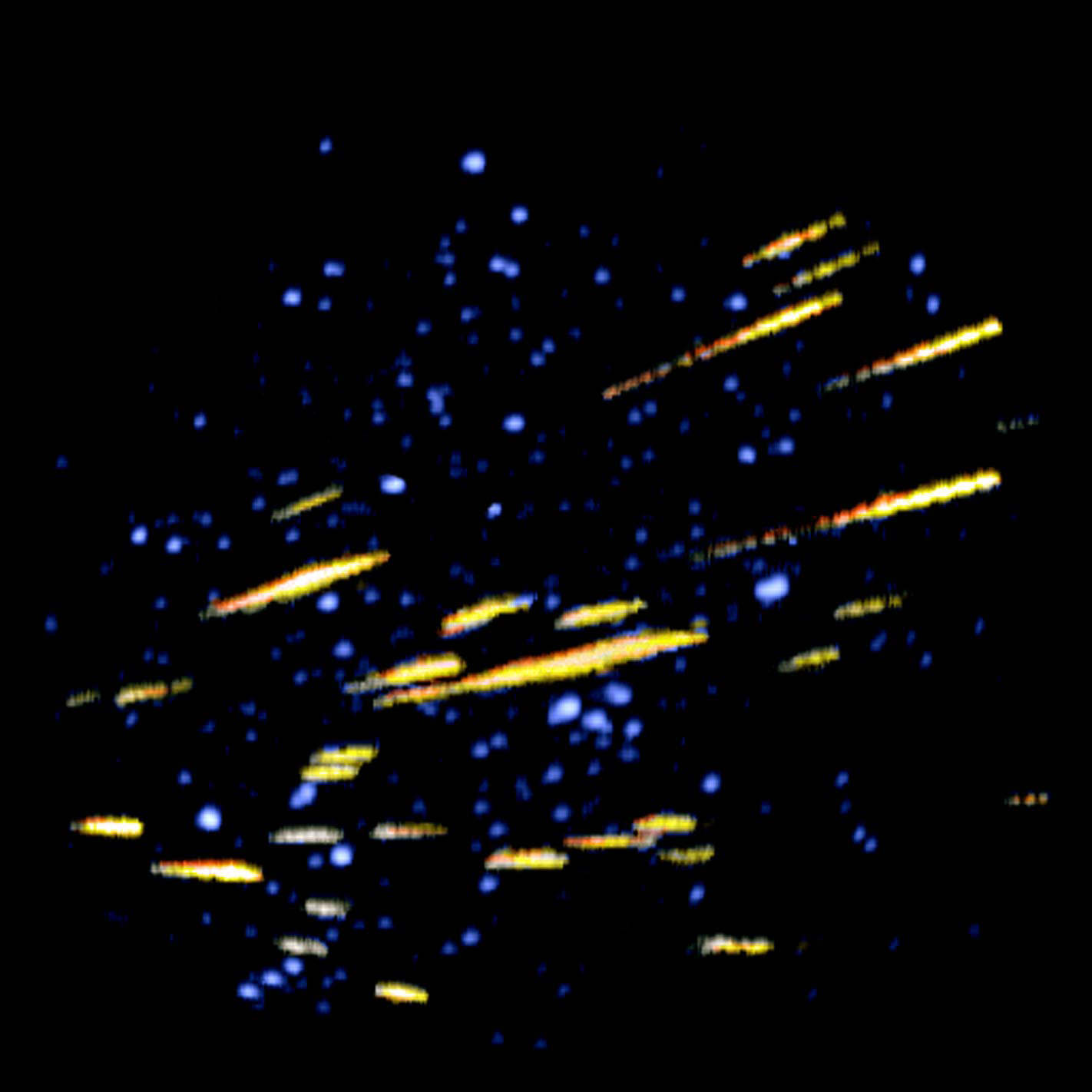
If you live in the Europe, North Africa, and the Middle East area, then keep watching the clock for 17-18:00 UTC when you may be in the right place at the right time for a burst of activity from the annual Draconid Meteor Shower. There's a possibility you might see up to 1,000 meteors an hour!

As always, meteor showers are unpredictable events - but that doesn't mean you can't be prepared or forewarned. While the gibbous Moon will put a damper on fainter meteor streaks, observers in Europe, North Africa, and the Middle East. are well situated to catch a strong pocket of activity.

"Meteor showers are as difficult to predict as rain showers. The Draconids have surprised us before, and they may do so again." says Canadian astronomer Paul Wiegert. "I’d encourage anyone outside on the night of October the 8 to look to the northern skies, just in case."

This isn't the first time the Draconid meteor shower has produced a brief storm. In 1933 and 1946 the activity reached an average hourly rate of 10,000. While that's pretty incredible, the same cometary debris trail left quite a show in the years 1952, 1985, and 1998 when it produced hundreds per hour. These remnants of Comet Giacobini-Zinner aren't the most dramatic of all showings - but knowing where the meteoroid stream is located makes such predictions valid.

When and where? In this case, start your observations just as soon as the sky gets dark. Since Draco is a northern constellation, those at high latitudes are move favored (sorry, southern hemisphere), so face toward the north and get comfortable. While the storm prediction will happen during daylight hours for North American observers, don't give up hope! It looks like clear skies for many of us and chances are above average for catching a shooting star.

When opportunity knocks, ya' gotta' be there to open the door...


And don't despair if you don't live in Europe, North Africa, and the Middle East, or if you get clouded out. You can still watch and listen to meteors enter the atmosphere on Spaceweather radio. Meteors reflect radio signals as they burn up and you can hear this as eerie whistles and pings.

A similar system, still employing the radio reflection method displays meteors coming in on your computer with a cool graph - The Meteorwatch Live View

And follow Universe Today's Adrian West on his Twitter feed, VirtualAstro and on his website MeteorWatch as he'll be providing updates on observed meteor rates in various parts of the world.

For Further Reading: Wiegert’s original announcement via Physorg.com. Meteor Burst photo courtesy of NASA.

Need an Excuse to Gaze at the Moon? International Observe the Moon Night is Coming!

Original Story by Nancy Atkinson


This photo of the Moon was taken on October 2, 2011 in Angera, Lombardy, IT. Credit: Milo.


Most of us space-minded folks don’t need an excuse to gaze upon the brightest object in the night sky – our own Moon. But just in case you need a reason or are hoping to convince some friends or family to take a look with you, there’s a special event coming up that encourages more people to take the time to take a gander at our closest and constant companion in space. Saturday, October 8, 2011 is the second annual International Observe the Moon Night (InOMN). Across the country and around the world, astronomy clubs, museums, observatories, parks, and schools will hold special events to introduce the public to the Moon. There will be telescopes to look through, activities to join, and presentations from experts in lunar science will be streamed to participating event locations.

“There will hundreds of events world-wide that will share the excitement of lunar science and explorations” said Brian Day, from the NASA Lunar Science Institute, who is one of the organizers of the event.


This photo of the Moon was taken on October 4, 2011. Credit: Amar Mainkar.


In a podcast for 365 Days of Astronomy and NLSI, Day said that right now an especially exciting time to engage the public in the Moon. (Listen to the podcast here.) A new generation of robotic probes has brought about a revolution in our understanding of our nearest neighbor in space. Our long-held view of a non-changing and dry Moon is now being replaced with an appreciation for the Moon as a dynamic body with significant deposits of water ice, a fascinating history, and a thin atmosphere that may play a role in a potential lunar water cycle. “It is indeed a New Moon!” Day said.

There’s excitement on the amateur front, as well. “Recent developments in technology have allowed amateur astronomers to image the Moon in detail that previously was only attainable from orbiting spacecraft,” Day said. “The work that they are doing and the imagery they are getting is just fantastic So, this is a great time to appreciate what is happening with the Moon on both the amateur and professional communities.”

The overall goal for InOMN is to engage lunar science and education communities, amateur astronomers, space enthusiasts, and the general public in what has become an annual lunar observation campaign.

“The Moon will be at a favorable phase, and we are going to be able to see some really magnificent features,” Day said, “so it is a good time to show up at an International Observe the Moon Night event and take a look at what is happening in the sky.”


This image of the Moon was taken on Oct. 5, 2011. Credit: Marcopic3000.


For more information and to find an InOMN event near you or to learn how to conduct your own InOMN event, visit http://www.observethemoonnight.org. The website includes information on events around the world, activities and downloadable information to allow you to host your own event, and much more.

The Crab Gets Cooked With Gamma Rays

Written By Tammy Plotner


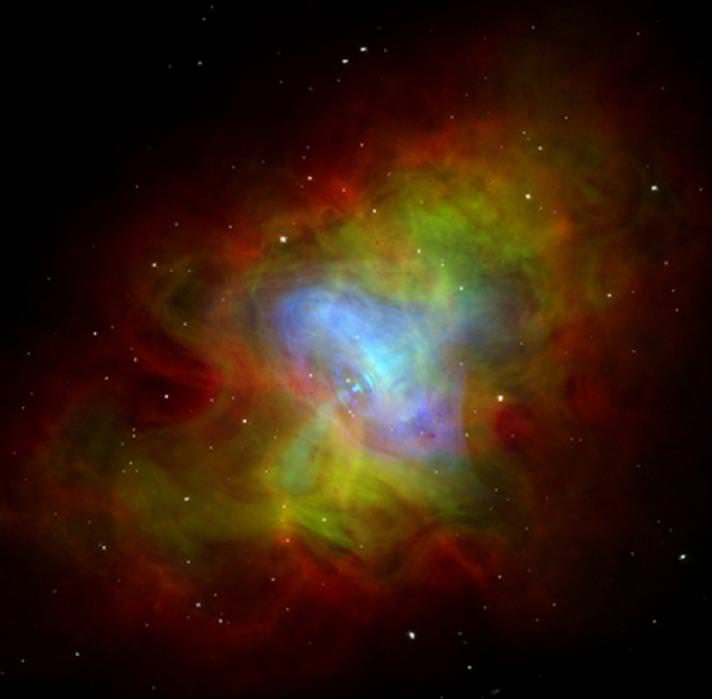
X-ray: NASA/CXC/ASU/J. Hester et al.; Optical: NASA/HST/ASU/J. Hester et al.; Radio: NRAO/AUI/NSF Image of the Crab Nebula combines visible light (green) and radio waves (red) emitted by the remnants of a cataclysmic supernova explosion in the year 1054. and the x-ray nebula (blue) created inside the optical nebula by a pulsar (the collapsed core of the massive star destroyed in the explosion). The pulsar, which is the size of a small city, was discovered only in 1969. The optical data are from the Hubble Space Telescope, and the radio emission from the National Radio Astronomy Observatory, and the X-ray data from the Chandra Observatory.


It's one of the most famous sights in the night sky... and 957 years ago it was bright enough to be seen during the day. This supernova event was one of the most spectacular of its kind and it still delights, amazes and even surprises astronomers to this day. Think there's nothing new to know about M1? Then think again...

Wednesday, September 21, 2011

Big Ol' Black Hole Jets

Written By Tammy Plotner


Some 20,000 light years away, a black hole named GX 339-4 has produced one of the most exciting visible events possible - a massive flare. This searing jet is an extraordinary occurrence and astronomers using NASA's Wide-field Infrared Survey Explorer (WISE) were able to capture elusive data to further refine their studies of the extreme environments surrounding black holes.

Friday, September 16, 2011

Even Small Galaxies Can Have Big Black Holes

Written By Tammy Plotner

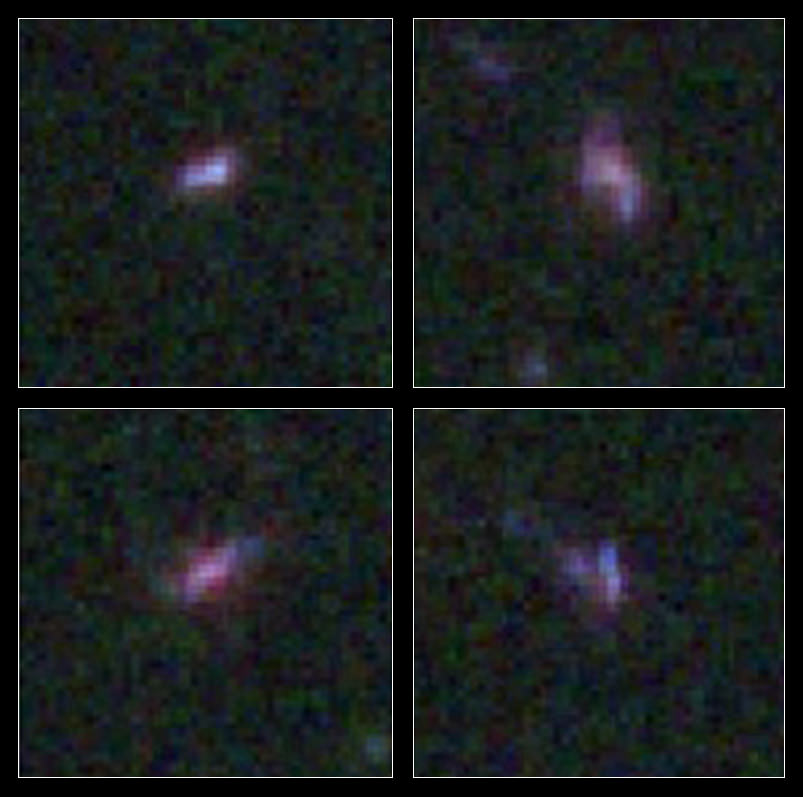
Astronomers detected supermassive black holes in 28 distant, low-mass galaxies, including the four shown in these Hubble Space Telescope images. Image credit: A. Koekemoer, Space Telescope Science Institute.


The Hubble Space Telescope has done it again. By utilizing a slitless grism, the Wide Field Camera 3 has uncovered evidence that supermassive black holes are right at home in some very small galaxies. Apparently these central black holes began their life when their host galaxies were first forming!

Sunday, September 4, 2011

NASA - Eyes On The Solar System

Submitted by Tammy Plotner


Are you ready for a fascinating virtual experience? Then check out "Eyes on the Solar System"! This clever compilation of visualizations and real images takes you on a journey that's sure to keep you entertained for hours!

If you've had the chance to use high dollar astronomy software, you'll appreciate this free program. Inside is a 3-D environment full of real NASA mission data which let's you explore the cosmos from the comfort of your computer. You can choose exploring an asteroid, scouring around a planet or taking a look at Earth from above. Fly with NASA's Voyager 2 spacecraft or join Casinni. You can even see the entire solar system moving in real time! Just check out a very small part of the features in this introductory video...


There's so much more there, too. Imagine the possibilities of Kepler, Lunar Reconnaissance Orbiter and the Spitzer Space Telescope! Move forward and backward in time... You're in command of this space journey! According to the developers, the awesome modeling team is current working on a number of spacecraft models. In the near future, expect to see finished models of Phoenix (cruise), Mars Exploration Rovers (cruise), Mars Science Laboratory (cruise), Mars Odyssey, and Mars Express. There are many spacecraft in the pipeline, so be patient!

While NASA's "Eyes on the Solar System" is compatible with Windows and Mac OS X, the partially Java-scripted format has a certain dependence on what browser is used. Firefox is recommended for smoothest operation, but it also works with IE and Safari. (I personally use Opera and encountered no problems - but avoid Chrome.) Other than that? Grab and comfy seat and take flight!

Friday, September 2, 2011

Great Weekend For Observing!

By Tammy Plotner

What an awesome weekend to have a small telescope or a pair of binoculars! There's lots of great things to observe and one of the best right now is Comet Garradd. You'll catch the bright - yet small - traveller cruising its way west out of Cygnus, not far from Beta. While you. As a matter of fact, why not stop at Albireo and enjoy this lovely binary's red and blue colors?! Head about 4 degrees south/south west and pick up another gem - Collinder 399 - better known as the "Coathanger" cluster. It will appear as an upside down "2" to a wide field view. Just check out the interaction with the comet that happened on August 1!


Need more? Then this is your chance to take in a supernova event, too. Let's give a listen to Dr.Peter Nugent, an astrophysicist from Lawrence Berkeley National Labs as he explains just how to find this star that exploded about 21 million light years away.


Still not enough? How about an occultation? On the evening of Saturday, September 3rd, the dark edge of the Moon will cover the 2.3-magnitude star Delta Scorpii from the eastern and southern U.S. Check with IOTA for specific times and locations.

So what are you waiting for? Get thee into the dark and enjoy!

Many thanks to John Chumack for the image of the "Comet and the Coathanger"!