Written by Tammy Plotner
Greetings, fellow SkyWatchers! It's going to be another great week. We have a host of unusual stars for you to explore - along with another meteor shower, a bit of history and even the upcoming solstice! Come on outside and join us... Because here's what's up!
Friday, December 16 - Tonight we’ll try our skills at observing an interesting variable star. RT (star 48) Aurigae is a bright Cepheid that is located roughly halfway between Epsilon Geminorum and Theta Aurigae. This perfect example of a pulsating star follows a precise timetable of 3.728 days and fluxes by close to one magnitude. Located 1600 light-years away, RT was first discovered in 1905 by T. H. Astbury of the British Astronomical Association. Like all Cepheids, it expands and contracts rhythmically - for reasons science is not completely sure of. Yet, we do know that it takes about 1.5 days for it to expand to its largest and brightest and 2.5 days for it to contract, cool, and dim.
Saturday, December 17 - Want a challenging double this evening? Then let's have a look at Theta Aurigae located on the east side of the pentagonal shape of this constellation. Located about 110 light-years away, 2.7 magnitude Theta is a four star system, whose members range in magnitude from 2.7 to 10.7. Suited even to a small telescope, the brightest member - Theta B - is itself a binary at magnitude 7.2, and was first recorded by Otto Struve in 1871. The pair moves quite slowly, and may take as long as 800 years to orbit each other at their separation of about 110 AU. The furthest member of this system was also noted by Struve as far back as 1852, but it is not a true member - the separation only occurring thanks to Theta's own proper motion. While you are there, be sure to note Theta's unusual color. While it will appear "white," look closely at the diffraction caused by our own atmosphere which acts much like a prism... You'll notice a lot more purple and blue around this star than many others of the same spectral type. Why? Theta is a silicon star!
Sunday, December 18 - Tonight let's head for Alpha Persei (Mirfak). While there's nothing particularly interesting about this 570 light-year distant star, what is incredible is the field in which it resides! Take a look at lowest power with a rich field telescope or binoculars and be prepared to be blown away... This is the Alpha Persei moving group - a fantastic field of main sequence stars that contains a little over 100 members. Even though it will take 90,000 years before any perceptible change is seen in this bright collection, they are happily moving at a pace of about 16 kilometers per second towards Beta Tauri! Enjoy this fine group also known as Melotte 20...
Monday, December 19 - Tonight is the peak of the Delta Arietid meteor shower. While most showers are best after midnight, this is an early evening shower that must be viewed before the radiant sets. The fall rate is modest - about 12 per hour. Today marks the founding of Mt. Wilson Solar Observatory. It officially opened its doors in 1904. We also celebrate the birth of Walter S. Adams on this date. Born in 1876, Adams was the astronomer at Mt. Wilson who revealed the nature of Sirius B, the first known white dwarf star. Sirius B was first seen by Alvan Clark in 1862 and most recently, the Hubble Space Telescope precisely measured the mass of B for the first time.
While Sirius is far too low at an early hour to study its white dwarf, we can have a look at a similar star when we view Omicron 2 Eridani located roughly a handspan west of Rigel. As the southernmost of the Omicron pair, it is sometimes known as 40 Eridani, and you'll find it to be an interesting multiple star system that's very worthy of your time. Discovered by William Herschel in 1783, this 16 light-year distant system is the eighth nearest of the unaided visible stars. Well spaced from the primary, the companion star is also a double for high powers and will reveal a red dwarf discovered by Otto Struve. Now, look closely at the 9th magnitude B star. This is the only white dwarf that can be considered "easy" for the backyard telescope. Its diameter is only about twice the size of Earth and its mass is about that of our Sun. Power up and locate the 11th magnitude companion - for it's one of the least massive stars known! And this white dwarf may be the smallest stellar object visible in an amateur telescope - it would be like spotting a tennis ball...on the Moon!
Tuesday, December 20 -While we're out tonight, let's have a look at one of the best known double stars in the night - Gamma Arietis (RA 01 53 31.81 Dec +19 17 37.9). Also known as Mesarthim, this combined magnitude 4 beauty was unintentionally discovered in 1664 by Robert Hooke who was following a comet. While no real change has been spotted in the more than 343 years since that time, there has been a slight difference detected in the components' radial velocities. Roughly 160 light-years away, you'll enjoy this almost matched-magnitude pair of white stars - but look carefully: in 1878, S. W. Burnham found a third star nearby that might not be a physical member, but is also a double!
Wednesday, December 21 - Up early? Fantastic! In the pre-dawn hours of this morning, I have a treat for you - the Ursid meteor shower! Cruising around the Sun about every thirteen and a half years, Comet 8P/Tuttle sheds a little skin. Although it never passes inside of Earth's orbit, some six years later we pass through its debris stream. Not so unusual? Then think again, because it takes as much as six centuries before the meteoroid trail is affected enough by Jupiter's gravitation to deflect the stream into our atmosphere. With little interference from the Moon while watching this circumpolar meteor shower, the hours before dawn could see activity of up to 12 per hour. By keeping watch on the constellation of Ursa Major, you just might spot one of these slow moving, 600 year old travelers that make their path only halfway between us and Selene!
Today marks Winter Solstice - for the northern hemisphere, the shortest day and the longest night of the year - and the point when the Sun is furthest south. Now is a wonderful time to demonstrate for yourself our own movements by choosing a "solstice marker." Anything from a fence post to a stick in the ground will suffice! Simply measure the shadow when the Sun reaches the zenith and repeat your experiment in the weeks ahead and watch as the shadow grows shorter...and the days grow longer!
Thursday, December 22 - Tonight we’ll look at a tremendous star as we head 150 light-years away to Menkar... Better known as Alpha Ceti, you'll find this nearly second magnitude giant orange beauty just west of Orion's "bow" (RA 03 02 16.77 Dec +04 05 23.0). With even a small telescope, you will also see 5th magnitude 93 Ceti in the eyepiece as well! Although they are not a true physical pair (the blue 93 is 350 light-years further away), they make a wonderful color contrast which is well worth your time. Just think... If 93 were as close as Menkar, it would be 250% brighter. But up the magnification and see if you can spot another true double in the field!
Until next week? May all your journeys be at light speed...
Friday, December 16, 2011


Monday, December 12, 2011
Product Spotlight - The Celestron Green Laser Finderscope Kit
Written by Tammy Plotner
Now here's a product that's simple, easy-to-use and really adds to your relaxing observing nights. If you're like I am, you have a star chart imprinted in your head, but sometimes it's hard to aim your telescope at exactly where it needs to be. Sure, a red dot finder is nice, so are ones with an illuminated reticle. But there are times when I just can't get my head at the right angle to see through them - or the guide stars I need to use aren't bright enough to show up well. An optical finderscope has been my best companion over the years, but even with this time-honored method, I can run up against some problems - like too many stars in the field of view! Of course, I can always rely on setting circles or a computer program, but that's not what I want. What I want is to be able to point my telescope to a certain area in the sky - just like pointing my finger at exactly where I know something is at.
Enter the Celestron Green Laser Finderscope...
Just like using the green laser to point out certain stars, this clever device takes the place of your finderscope and delivers with point and shoot ease. When you take the time to line it up accurately, it will give you back amazingly accurate results. For example, if you know where M11 is located, just switch on the laser, put the beam on the mark and you're there. Not only does this aid you in pointing your telescope, but others around you can utilize your finding beam... from smaller telescopes using an optical finder, to someone using binoculars.

The Celestron Green Laser Finderscope is small, neat and clean. It's not any larger than your average supplied finderscope and close to the same weight. It comes with a supplied bracket that fits almost any standard dovetail mount and one for your SCT, too. What's more, it can be detached and handheld for those moments when you need it. And yes, the "Off/On" switch is a little stiff, but it's worth it as a safety precaution. The battery life is about the same as a red dot finder and it is bright enough to cut through most situations. All in all, it's a fine product at a modest investment - and one that will make your observing nights - and aiming your telescope - a lot more pleasant!
You can get a Celestron Green Laser Finderscope at OPT today!
Now here's a product that's simple, easy-to-use and really adds to your relaxing observing nights. If you're like I am, you have a star chart imprinted in your head, but sometimes it's hard to aim your telescope at exactly where it needs to be. Sure, a red dot finder is nice, so are ones with an illuminated reticle. But there are times when I just can't get my head at the right angle to see through them - or the guide stars I need to use aren't bright enough to show up well. An optical finderscope has been my best companion over the years, but even with this time-honored method, I can run up against some problems - like too many stars in the field of view! Of course, I can always rely on setting circles or a computer program, but that's not what I want. What I want is to be able to point my telescope to a certain area in the sky - just like pointing my finger at exactly where I know something is at.
Enter the Celestron Green Laser Finderscope...
Just like using the green laser to point out certain stars, this clever device takes the place of your finderscope and delivers with point and shoot ease. When you take the time to line it up accurately, it will give you back amazingly accurate results. For example, if you know where M11 is located, just switch on the laser, put the beam on the mark and you're there. Not only does this aid you in pointing your telescope, but others around you can utilize your finding beam... from smaller telescopes using an optical finder, to someone using binoculars.
The Celestron Green Laser Finderscope is small, neat and clean. It's not any larger than your average supplied finderscope and close to the same weight. It comes with a supplied bracket that fits almost any standard dovetail mount and one for your SCT, too. What's more, it can be detached and handheld for those moments when you need it. And yes, the "Off/On" switch is a little stiff, but it's worth it as a safety precaution. The battery life is about the same as a red dot finder and it is bright enough to cut through most situations. All in all, it's a fine product at a modest investment - and one that will make your observing nights - and aiming your telescope - a lot more pleasant!
You can get a Celestron Green Laser Finderscope at OPT today!
Friday, December 9, 2011
Weekly SkyWatcher's Forecast - December 9-15, 2011
Written by Tammy Plotner
Are you prepared for a great week of astronomy observations? Then you're going to enjoy meteors showers, a lunar eclipse, astronomy history, colorful stars and much, much more! When you're ready, let's head out to the backyard...
Friday, December 9 - If you are out stargazing, look for the peak of the Monocerid meteor shower. Its fall rate is around one per hour and its radiant point is near Gemini. While the bright Moon will interfere with this faint shower, you never know when you might catch a “shooter”!
Tonight is Full Moon and it has been given names such as the “Cold Moon” or “Long Nights Moon.” This is the time of winter cold and nights have become long and dark. In some cultures, this is also called the “Moon before Yule.” No matter what it’s called, early winter nights are indeed long and cold. Look for Luna moving high across the sky, opposite the now low Sun.
Saturday, December 10 - For Central and West Coast observers, don’t forget this is eclipse morning! Be sure to check our previous blog entry for more information!
On this date in 1863, Annie Jump Cannon was born. She was a United States astronomer who created the modern system for classifying stars by their spectra. Why not celebrate this achievement by coming along with me and viewing some very specific stars that have unusual visual spectral qualities! Let's grab a star chart, brush up on our Greek letters and start first with Mu Cephei.
Nicknamed the "Garnet Star," this is perhaps one of the reddest stars visible to the unaided eye. At around 1200 light-years away, this spectral type M2 star will show a delightful blue/purple "flash." If you still don't perceive color, try comparing Mu to its bright neighbor Alpha, a spectral type A7, or "white," star. Perhaps you'd like something a bit more off the beaten path? Then head for S Cephei about halfway between Kappa and Gamma toward the pole. Its intense shade of red makes this magnitude 10 star an incredibly worthwhile hunt.
To see an example of a B spectrum star, look no further than the Pleiades... All the components are blue white. Want to taste an "orange?" Then look again at Aldeberan, or Alpha Tauri, and say hello to a K spectrum star. Now that I have your curiosity aroused, would you like to see what our own Sun would look like? Then choose Alpha Aurigae, better known as Capella, and discover a spectral class G star that's only 160 times brighter than the one that holds our solar system together! If you're enjoying the game, then have a look at a star with one of the most unusual spectra of all - Theta Aurigae. Theta is actually a B class, or a blue/white, but instead of having strong lines in the helium, it has an abnormal concentration of silicon, making this incredibly unusual double star seem to glitter like a "black diamond."
Still no luck in seeing color? Don't worry. It does take a bit of practice! The cones in our eyes are the color receptors and when we go out in the dark, the color-blind rods take over. By intensifying the starlight with either a telescope or binoculars, we can usually excite the cones in our dark-adapted eyes to pick up on color.
Tonight is also the peak of the Sigma Hydrid meteor stream. Its radiant is near the head of the Serpent and the fall rate is also 12 per hour - but these are fast! I wish I could take away the Moon “shine” for you, but you just might spot one despite the light!
Sunday, December 11 - Today in 1961, OSCAR-1 was launched. The project started in 1960; the name stands for Orbital Satellite Carrying Amateur Radio. OSCAR-1 operated in orbit for 22 days, transmitting a signal in Morse Code - the simple greeting "Hi." The success of the mission helped to promote interest in amateur radio which still continues to this day!
Tonight before the Moon interferes with fainter studies, let's head far north for one of the oldest galactic clusters in our visible sky - NGC 188.
Hovering near Polaris (RA 00 44.5 Dec +85 20) this circumpolar open cluster also goes by other names: Collinder 1 and Melotte 2. Discovered by John Herschel on November 3, 1831, this 8th magnitude collection of faint stars will require a telescope to resolve its 120 members. At one time, it was believed to be as old as 24 billion years, later updated to 12 billion; but it is now considered to be around 5 billion years old. No matter how old it may truly be, it is one of the time-honored great studies and is also number one on the Caldwell list!
Monday, December 12 - Today in 1920, the first stellar diameter was measured by Francis Pease with an interferometer at Mt. Wilson. His target? Betelgeuse!
Tonight will being be one of the most hauntingly beautiful and most mysterious displays of celestial fireworks all year - the Geminid meteor shower. First noted in 1862 by Robert P. Greg in England, and B. V. Marsh and Prof. Alex C. Twining of the United States in independent studies, the annual appearance of the Geminid stream was weak initially, producing no more than a few per hour, but it has grown in intensity during the last century and a half. By 1877 astronomers realized a new annual shower was occurring with an hourly rate of about 14. At the turn of the century, it had increased to over 20, and by the 1930s up to 70 per hour. Only eight years ago observers recorded an outstanding 110 per hour during a moonless night... And, unfortunately, the Moon will soon interfere with observations. But no worries! We have a while yet to watch. Let’s talk…
So why are the Geminids such a mystery? Most meteor showers are historic - documented and recorded for hundred of years - and we know them as being cometary debris. When astronomers first began looking for the Geminids' parent comet, they found none. It wasn't until October 11, 1983 that Simon Green and John K. Davies, using data from NASA's Infrared Astronomical Satellite, detected an orbital object (confirmed the next night by Charles Kowal) that matched the Geminid meteoroid stream. But this was no comet, it was an asteroid.
Originally designated as 1983 TB, but later renamed 3200 Phaethon, this apparently rocky solar system member has a highly elliptical orbit that places it within 0.15 AU of the Sun about every year and half. But asteroids can't fragment like a comet - or can they? The original hypothesis was that since Phaethon's orbit passes through the asteroid belt, it may have collided with other asteroids creating rocky debris. This sounded good, but the more we studied the more we realized the meteoroid "path" occurred when Phaethon neared the Sun. So now our asteroid is behaving like a comet, yet it doesn't develop a tail.
So what exactly is this "thing?" Well, we do know that 3200 Phaethon orbits like a comet, yet has the spectral signature of an asteroid. By studying photographs of the meteor showers, scientists have determined that the meteors are denser than cometary material and not as dense as asteroid fragments. This leads us to believe that Phaethon is probably an extinct comet that has gathered a thick layer of interplanetary dust during its travels, yet retains the ice-like nucleus. Until we are able to take physical samples of this "mystery," we may never fully understand what Phaethon is, but we can fully appreciate the annual display it produces!
Thanks to the wide path of the stream, folks the world over get an opportunity to enjoy the show. The traditional peak time is tonight as soon as the constellation of Gemini appears around mid-evening. The radiant for the shower is right around bright star Castor, but meteors can originate from many points in the sky. From around 2 am tonight until dawn (when our local sky window is aimed directly into the stream) it's possible to see about one "shooting star" every 30 seconds. The most successful of observing nights are ones where you are comfortable, so be sure to use a reclining chair or pad the ground while looking up. Please get away from light sources when possible - it will triple the amount of meteors you see. Enjoy the incredible and mysterious Geminids!
Tuesday, December 13 - Today was a very busy day in astronomy history. Tycho Brahe was born in 1546. Brahe was a Danish pre-telescopic astronomer who established the first modern observatory in 1582 and gave Kepler his first job in the field. In 1962, Mariner 2 made a flyby of Venus and became the first successful interplanetary probe.
With some time before before Moonrise, let’s journey to a sparse portion of the Milky Way now high in the north just after skydark. Start by locating the two circumpolar constellations Cepheus and Cassiopeia and split the distance between Beta Cassiopeiae and Delta Cephei. Notice the stepping stones of 5th and 6th magnitude stars connecting them. Halfway between our two marker stars, go due south half a fist’s width. This brings us to a region of some 5 degrees in diameter devoid of stars brighter than magnitude 6.5. Sweep the area with binoculars or a telescope. Any suggestions as to why a 20 square degree area of the Milky Way would be so deficient in visible stars? Think obscure…
Wednesday, December 14 - Today in 1970, the Soviet spacecraft Venera 7 registered a first as it made a successful soft landing on Venus, and so went into the history books as the first craft to land on another planet.
Now let's travel 398 light-years away as we have a look at AR Aurigae - the centermost star in a brilliant collection. It is about one-third the distance from southern Beta to northern Alpha (Capella). AR is an eclipsing binary which consists of two main sequence white dwarf stars. About every 4.1 days, this pair will make a slight magnitude drop. While both are chemically peculiar, neither fills its Roche Lobe - meaning they are not stripping material from each other to cause these unusual abundances. Recent studies have shown the possibility of a third, unseen companion! But even binoculars will see that AR resides in a great field of stars and is worth a little of your time...
Thursday, December 15 - Today we celebrate the birthday of Edward Emerson (E. E.) Barnard. Born in 1857, Barnard was an American observational astronomer and an absolute legend. He led a very colorful life in astronomy, and his sharp skills have led to a multitude of discoveries. His life was a very fascinating one: Barnard was often known to simply set the scope on one point in the sky and just watch for new objects as the field moved! Tonight let's take a look at a bright star that has Barnard's touch, as we explore Beta Aurigae - Menkalinan.
First identified as a spectroscopic binary by A. Maury in 1890, Beta itself is part of a moving group of stars that includes Sirius, and is an Algol-type variable. While you won't see changes as dramatic as those of the "Demon Star," it has a precise drop of 0.09 magnitude every 3.96 days. This system contains almost identical stars which are more than two and a half times the size of our Sun, but they orbit each other at a distance of less than 0.1 AU! While Menkalinan's 10th magnitude optical companion was first spotted by Sir William Herschel in 1783, only E. E. Barnard noticed the 14th magnitude true tertiary to this incredible multiple system!
Until next week, ask for the Moon, but keep on reaching for the stars! ~Tammy
Are you prepared for a great week of astronomy observations? Then you're going to enjoy meteors showers, a lunar eclipse, astronomy history, colorful stars and much, much more! When you're ready, let's head out to the backyard...
Friday, December 9 - If you are out stargazing, look for the peak of the Monocerid meteor shower. Its fall rate is around one per hour and its radiant point is near Gemini. While the bright Moon will interfere with this faint shower, you never know when you might catch a “shooter”!
Tonight is Full Moon and it has been given names such as the “Cold Moon” or “Long Nights Moon.” This is the time of winter cold and nights have become long and dark. In some cultures, this is also called the “Moon before Yule.” No matter what it’s called, early winter nights are indeed long and cold. Look for Luna moving high across the sky, opposite the now low Sun.
Saturday, December 10 - For Central and West Coast observers, don’t forget this is eclipse morning! Be sure to check our previous blog entry for more information!
On this date in 1863, Annie Jump Cannon was born. She was a United States astronomer who created the modern system for classifying stars by their spectra. Why not celebrate this achievement by coming along with me and viewing some very specific stars that have unusual visual spectral qualities! Let's grab a star chart, brush up on our Greek letters and start first with Mu Cephei.
Nicknamed the "Garnet Star," this is perhaps one of the reddest stars visible to the unaided eye. At around 1200 light-years away, this spectral type M2 star will show a delightful blue/purple "flash." If you still don't perceive color, try comparing Mu to its bright neighbor Alpha, a spectral type A7, or "white," star. Perhaps you'd like something a bit more off the beaten path? Then head for S Cephei about halfway between Kappa and Gamma toward the pole. Its intense shade of red makes this magnitude 10 star an incredibly worthwhile hunt.
To see an example of a B spectrum star, look no further than the Pleiades... All the components are blue white. Want to taste an "orange?" Then look again at Aldeberan, or Alpha Tauri, and say hello to a K spectrum star. Now that I have your curiosity aroused, would you like to see what our own Sun would look like? Then choose Alpha Aurigae, better known as Capella, and discover a spectral class G star that's only 160 times brighter than the one that holds our solar system together! If you're enjoying the game, then have a look at a star with one of the most unusual spectra of all - Theta Aurigae. Theta is actually a B class, or a blue/white, but instead of having strong lines in the helium, it has an abnormal concentration of silicon, making this incredibly unusual double star seem to glitter like a "black diamond."
Still no luck in seeing color? Don't worry. It does take a bit of practice! The cones in our eyes are the color receptors and when we go out in the dark, the color-blind rods take over. By intensifying the starlight with either a telescope or binoculars, we can usually excite the cones in our dark-adapted eyes to pick up on color.
Tonight is also the peak of the Sigma Hydrid meteor stream. Its radiant is near the head of the Serpent and the fall rate is also 12 per hour - but these are fast! I wish I could take away the Moon “shine” for you, but you just might spot one despite the light!
Sunday, December 11 - Today in 1961, OSCAR-1 was launched. The project started in 1960; the name stands for Orbital Satellite Carrying Amateur Radio. OSCAR-1 operated in orbit for 22 days, transmitting a signal in Morse Code - the simple greeting "Hi." The success of the mission helped to promote interest in amateur radio which still continues to this day!
Tonight before the Moon interferes with fainter studies, let's head far north for one of the oldest galactic clusters in our visible sky - NGC 188.
Hovering near Polaris (RA 00 44.5 Dec +85 20) this circumpolar open cluster also goes by other names: Collinder 1 and Melotte 2. Discovered by John Herschel on November 3, 1831, this 8th magnitude collection of faint stars will require a telescope to resolve its 120 members. At one time, it was believed to be as old as 24 billion years, later updated to 12 billion; but it is now considered to be around 5 billion years old. No matter how old it may truly be, it is one of the time-honored great studies and is also number one on the Caldwell list!
Monday, December 12 - Today in 1920, the first stellar diameter was measured by Francis Pease with an interferometer at Mt. Wilson. His target? Betelgeuse!
Tonight will being be one of the most hauntingly beautiful and most mysterious displays of celestial fireworks all year - the Geminid meteor shower. First noted in 1862 by Robert P. Greg in England, and B. V. Marsh and Prof. Alex C. Twining of the United States in independent studies, the annual appearance of the Geminid stream was weak initially, producing no more than a few per hour, but it has grown in intensity during the last century and a half. By 1877 astronomers realized a new annual shower was occurring with an hourly rate of about 14. At the turn of the century, it had increased to over 20, and by the 1930s up to 70 per hour. Only eight years ago observers recorded an outstanding 110 per hour during a moonless night... And, unfortunately, the Moon will soon interfere with observations. But no worries! We have a while yet to watch. Let’s talk…
So why are the Geminids such a mystery? Most meteor showers are historic - documented and recorded for hundred of years - and we know them as being cometary debris. When astronomers first began looking for the Geminids' parent comet, they found none. It wasn't until October 11, 1983 that Simon Green and John K. Davies, using data from NASA's Infrared Astronomical Satellite, detected an orbital object (confirmed the next night by Charles Kowal) that matched the Geminid meteoroid stream. But this was no comet, it was an asteroid.
Originally designated as 1983 TB, but later renamed 3200 Phaethon, this apparently rocky solar system member has a highly elliptical orbit that places it within 0.15 AU of the Sun about every year and half. But asteroids can't fragment like a comet - or can they? The original hypothesis was that since Phaethon's orbit passes through the asteroid belt, it may have collided with other asteroids creating rocky debris. This sounded good, but the more we studied the more we realized the meteoroid "path" occurred when Phaethon neared the Sun. So now our asteroid is behaving like a comet, yet it doesn't develop a tail.
So what exactly is this "thing?" Well, we do know that 3200 Phaethon orbits like a comet, yet has the spectral signature of an asteroid. By studying photographs of the meteor showers, scientists have determined that the meteors are denser than cometary material and not as dense as asteroid fragments. This leads us to believe that Phaethon is probably an extinct comet that has gathered a thick layer of interplanetary dust during its travels, yet retains the ice-like nucleus. Until we are able to take physical samples of this "mystery," we may never fully understand what Phaethon is, but we can fully appreciate the annual display it produces!
Thanks to the wide path of the stream, folks the world over get an opportunity to enjoy the show. The traditional peak time is tonight as soon as the constellation of Gemini appears around mid-evening. The radiant for the shower is right around bright star Castor, but meteors can originate from many points in the sky. From around 2 am tonight until dawn (when our local sky window is aimed directly into the stream) it's possible to see about one "shooting star" every 30 seconds. The most successful of observing nights are ones where you are comfortable, so be sure to use a reclining chair or pad the ground while looking up. Please get away from light sources when possible - it will triple the amount of meteors you see. Enjoy the incredible and mysterious Geminids!
Tuesday, December 13 - Today was a very busy day in astronomy history. Tycho Brahe was born in 1546. Brahe was a Danish pre-telescopic astronomer who established the first modern observatory in 1582 and gave Kepler his first job in the field. In 1962, Mariner 2 made a flyby of Venus and became the first successful interplanetary probe.
With some time before before Moonrise, let’s journey to a sparse portion of the Milky Way now high in the north just after skydark. Start by locating the two circumpolar constellations Cepheus and Cassiopeia and split the distance between Beta Cassiopeiae and Delta Cephei. Notice the stepping stones of 5th and 6th magnitude stars connecting them. Halfway between our two marker stars, go due south half a fist’s width. This brings us to a region of some 5 degrees in diameter devoid of stars brighter than magnitude 6.5. Sweep the area with binoculars or a telescope. Any suggestions as to why a 20 square degree area of the Milky Way would be so deficient in visible stars? Think obscure…
Wednesday, December 14 - Today in 1970, the Soviet spacecraft Venera 7 registered a first as it made a successful soft landing on Venus, and so went into the history books as the first craft to land on another planet.
Now let's travel 398 light-years away as we have a look at AR Aurigae - the centermost star in a brilliant collection. It is about one-third the distance from southern Beta to northern Alpha (Capella). AR is an eclipsing binary which consists of two main sequence white dwarf stars. About every 4.1 days, this pair will make a slight magnitude drop. While both are chemically peculiar, neither fills its Roche Lobe - meaning they are not stripping material from each other to cause these unusual abundances. Recent studies have shown the possibility of a third, unseen companion! But even binoculars will see that AR resides in a great field of stars and is worth a little of your time...
Thursday, December 15 - Today we celebrate the birthday of Edward Emerson (E. E.) Barnard. Born in 1857, Barnard was an American observational astronomer and an absolute legend. He led a very colorful life in astronomy, and his sharp skills have led to a multitude of discoveries. His life was a very fascinating one: Barnard was often known to simply set the scope on one point in the sky and just watch for new objects as the field moved! Tonight let's take a look at a bright star that has Barnard's touch, as we explore Beta Aurigae - Menkalinan.
First identified as a spectroscopic binary by A. Maury in 1890, Beta itself is part of a moving group of stars that includes Sirius, and is an Algol-type variable. While you won't see changes as dramatic as those of the "Demon Star," it has a precise drop of 0.09 magnitude every 3.96 days. This system contains almost identical stars which are more than two and a half times the size of our Sun, but they orbit each other at a distance of less than 0.1 AU! While Menkalinan's 10th magnitude optical companion was first spotted by Sir William Herschel in 1783, only E. E. Barnard noticed the 14th magnitude true tertiary to this incredible multiple system!
Until next week, ask for the Moon, but keep on reaching for the stars! ~Tammy
Thursday, December 8, 2011
Total Lunar Eclipse - Saturday, December 10, 2011
Written by Tammy Plotner
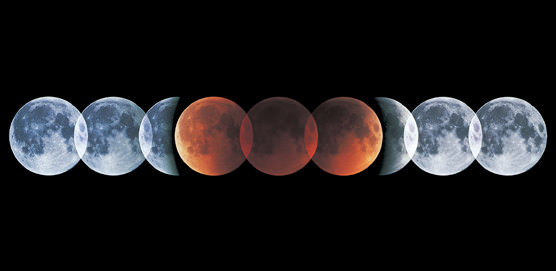
Are you ready for some good, old-fashioned observing fun? Although you might not want to get up early, it's going to be worth your time. This Saturday, December 10, 2011, marks the last total lunar eclipse event for the western portion of the Americas until 2014. While a solar eclipse event has a very small footprint where it is visible, a lunar eclipse has a wide and wonderful path that encompasses a huge amount of viewers. “We’re all looking at this together,” says Sky & Telescope senior editor Alan MacRobert.
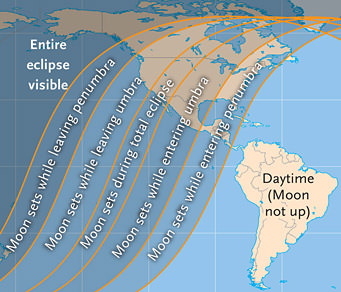 If you live in the eastern portion of the Americas, sorry... You'll miss out on this one. In the Central time zone, the Moon will be setting while it is partially eclipsed. However, beginning in a line that takes in Arizona and the Dakotas you'll be treated to the beginning of the lunar eclipse, totality, and it will set as it is beginning to come out of eclipse. If you live in the western portion of the US or Canada? Lucky you! You'll get to enjoy the Moon as it goes through the initial states of eclipse, see totality and even might catch the phases as it slips out of Earth's shadow again - just as the Sun begins to rise. For Skywatchers in Hawaii, Australia, and East Asia, you'll have it better. Seen from there, the whole eclipse happens high in a dark sky from start to finish. For Europe and Africa, the eclipsed Moon will be lower in the east during or after twilight on the evening of the 10th.
When exactly does the event begin? The lunar eclipse will be total from 6:05 to 6:57 a.m. Pacific Standard Time. The partial stage of the eclipse begins more than an hour earlier, at 4:45 a.m. PST. Be sure to watch the southern lunar edge, too. Because the Moon will be skimming by the southern edge of the Earth's shadow, it will remain slightly brighter and add to the dimensional effect you'll see. Enjoy the coppery colors from the refracted sunlight! The Moon won't be black - but it will most certainly be a very photogenic experience.
“That red light on the Moon during a lunar eclipse comes from all the sunrises and sunsets around the Earth at the time,” explains Sky & Telescope editor in chief Robert Naeye. “If you were an astronaut standing on the Moon and looking up, the whole picture would be clear. The Sun would be covered up by a dark Earth that was ringed all around with a thin, brilliant band of sunset- and sunrise-colored light -- bright enough to dimly illuminate the lunar landscape around you.”
May clear skies be yours!
Original News Source: Sky and Telescope News Release. Image Credits: Sky and Telescope. Be sure to visit Universe Today for the best in space news!
Are you ready for some good, old-fashioned observing fun? Although you might not want to get up early, it's going to be worth your time. This Saturday, December 10, 2011, marks the last total lunar eclipse event for the western portion of the Americas until 2014. While a solar eclipse event has a very small footprint where it is visible, a lunar eclipse has a wide and wonderful path that encompasses a huge amount of viewers. “We’re all looking at this together,” says Sky & Telescope senior editor Alan MacRobert.
If you live in the eastern portion of the Americas, sorry... You'll miss out on this one. In the Central time zone, the Moon will be setting while it is partially eclipsed. However, beginning in a line that takes in Arizona and the Dakotas you'll be treated to the beginning of the lunar eclipse, totality, and it will set as it is beginning to come out of eclipse. If you live in the western portion of the US or Canada? Lucky you! You'll get to enjoy the Moon as it goes through the initial states of eclipse, see totality and even might catch the phases as it slips out of Earth's shadow again - just as the Sun begins to rise. For Skywatchers in Hawaii, Australia, and East Asia, you'll have it better. Seen from there, the whole eclipse happens high in a dark sky from start to finish. For Europe and Africa, the eclipsed Moon will be lower in the east during or after twilight on the evening of the 10th.When exactly does the event begin? The lunar eclipse will be total from 6:05 to 6:57 a.m. Pacific Standard Time. The partial stage of the eclipse begins more than an hour earlier, at 4:45 a.m. PST. Be sure to watch the southern lunar edge, too. Because the Moon will be skimming by the southern edge of the Earth's shadow, it will remain slightly brighter and add to the dimensional effect you'll see. Enjoy the coppery colors from the refracted sunlight! The Moon won't be black - but it will most certainly be a very photogenic experience.
“That red light on the Moon during a lunar eclipse comes from all the sunrises and sunsets around the Earth at the time,” explains Sky & Telescope editor in chief Robert Naeye. “If you were an astronaut standing on the Moon and looking up, the whole picture would be clear. The Sun would be covered up by a dark Earth that was ringed all around with a thin, brilliant band of sunset- and sunrise-colored light -- bright enough to dimly illuminate the lunar landscape around you.”
May clear skies be yours!
Original News Source: Sky and Telescope News Release. Image Credits: Sky and Telescope. Be sure to visit Universe Today for the best in space news!
Wednesday, December 7, 2011
Staking Out Vampire Stars
Written by Tammy Plotner
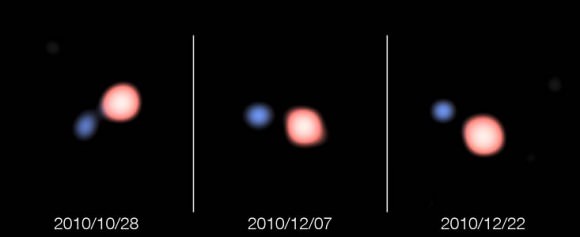
How do you peer into the dark heart of a vampire star? Try combining four telescopes! At ESO’s Paranal Observatory they created a virtual telescope 130 metres across with vision 50 times sharper than the NASA/ESA Hubble Space Telescope and observed a very unusual event... the transfer of mass from one star to another. While you might assume this to be a violent action, it turns out that it's a gradual drain. Apparently SS Leporis stands for "super slow".
“We can now combine light from four VLT telescopes and create super-sharp images much more quickly than before,” says Nicolas Blind (IPAG, Grenoble, France), who is the lead author on the paper presenting the results, “The images are so sharp that we can not only watch the stars orbiting around each other, but also measure the size of the larger of the two stars.”
This stellar duo, cataloged as SS Leporis, are only separated by slightly more than one AU and have an orbital period of 260 days. Of the two, the more massive and cooler member expands to a size of about Mercury's orbit. It's this very action of being pushed closer that draws the hot companion to feed on its host - consuming almost half of its mass. Weird? You bet.
“We knew that this double star was unusual, and that material was flowing from one star to the other,” says co-author Henri Boffin, from ESO. “What we found, however, is that the way in which the mass transfer most likely took place is completely different from previous models of the process. The ‘bite’ of the vampire star is very gentle but highly effective.”
The technique of combining telescopes gives us an incredibly candid image - one which shows us the larger star isn't quite as large as surmised. Rather than clarifying the picture, it complicates. Just how did a red giant lose matter to its companion? Researchers are guessing rather than streaming material from one star to another, that stellar winds may have released mass - only to be collected by the companion vampire star.
“These observations have demonstrated the new snapshot imaging capability of the Very Large Telescope Interferometer. They pave the way for many further fascinating studies of interacting double stars,” concludes co-author Jean-Philippe Berger.
Where's van Helsing when you need him?
Original Story Source: ESO Press Release For Further Reading: An Incisive Look At The Symbiotic Star SS Leoporis. Image Credit: Credit: ESO/PIONIER/IPAG
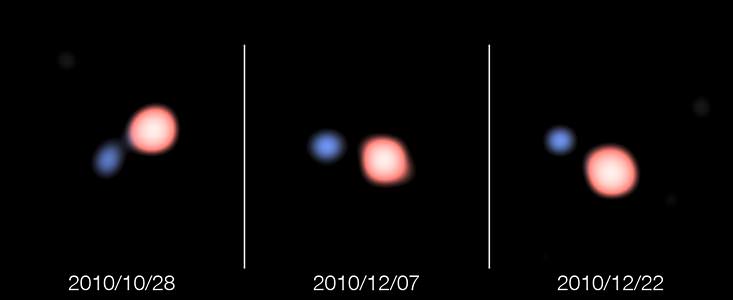
How do you peer into the dark heart of a vampire star? Try combining four telescopes! At ESO’s Paranal Observatory they created a virtual telescope 130 metres across with vision 50 times sharper than the NASA/ESA Hubble Space Telescope and observed a very unusual event... the transfer of mass from one star to another. While you might assume this to be a violent action, it turns out that it's a gradual drain. Apparently SS Leporis stands for "super slow".
“We can now combine light from four VLT telescopes and create super-sharp images much more quickly than before,” says Nicolas Blind (IPAG, Grenoble, France), who is the lead author on the paper presenting the results, “The images are so sharp that we can not only watch the stars orbiting around each other, but also measure the size of the larger of the two stars.”
This stellar duo, cataloged as SS Leporis, are only separated by slightly more than one AU and have an orbital period of 260 days. Of the two, the more massive and cooler member expands to a size of about Mercury's orbit. It's this very action of being pushed closer that draws the hot companion to feed on its host - consuming almost half of its mass. Weird? You bet.
“We knew that this double star was unusual, and that material was flowing from one star to the other,” says co-author Henri Boffin, from ESO. “What we found, however, is that the way in which the mass transfer most likely took place is completely different from previous models of the process. The ‘bite’ of the vampire star is very gentle but highly effective.”
The technique of combining telescopes gives us an incredibly candid image - one which shows us the larger star isn't quite as large as surmised. Rather than clarifying the picture, it complicates. Just how did a red giant lose matter to its companion? Researchers are guessing rather than streaming material from one star to another, that stellar winds may have released mass - only to be collected by the companion vampire star.
“These observations have demonstrated the new snapshot imaging capability of the Very Large Telescope Interferometer. They pave the way for many further fascinating studies of interacting double stars,” concludes co-author Jean-Philippe Berger.
Where's van Helsing when you need him?
Original Story Source: ESO Press Release For Further Reading: An Incisive Look At The Symbiotic Star SS Leoporis. Image Credit: Credit: ESO/PIONIER/IPAG
Monday, December 5, 2011
Product Spotlight - Celestron Digital Weather Stations
Written by Tammy Plotner
Interested in the weather? Want to monitor observing conditions in your location? Do you like fun, science-oriented equipment? Then you need to check out the Celestron Digital Weather Stations for your home, office, cabin, observatory, or other location. These handy - and affordable - gadgets come loaded with features which are not only useful, but educational as well. Curious? Then read on...
For those who make astronomical observations, we know there's a lot of information that needs to be included in a report and how many times have you wished you could get it all in one easy place? Now you can with the Celestron Compact Weather Station....

This ingenious little device measures only 3.1" x 1.8" x 5.6" (79mm x 46mm x 142mm) and weighs just 5 ounces. One look at the display screen of the Celestron Compact Weather Station and you'll instantly know the moon phase, time, date, temperature displays indoor and outdoor in either F or C, humidity both indoors and out and cloud cover. Other features include a weather forecast, digital quartz alarm clock with snooze, alert for minimum and maximum indoor temperature... and even a calendar that displays month, day, day of week!
For astrophotographers and astronomers, there's nothing more important than having all your weather information and so much more handy before a night's observing. Why clutter up your work space with several gadgets when you can have them all in one neat, compact unit? Check out all the features of the Celestron Compact Barometric Weather Station! The Celestron Compact Barometric Weather Station offers up a temperature sensor that displays indoor and outdoor in either F or C, a built-in hygrometer that gives you a readout of indoor humidity, and built-in barometer which provides indication of current weather and atmospheric pressure. But that's not all...

Time is important and the built-in quartz clock provides accuracy along with an alarm and snooze feature. The internal calendar displays month, day, day of week - along with moon phase and tide information. There's even an alert feature for minimum and maximum for indoor and outdoor temperature!
 The Celestron Deluxe Weather Station simply rocks. In just this little unit you'll get all the information you need, such as indoor and outdoor temperature and humidity, weather forecast, wind chill, speed, gust and direction, ice alert, dewpoint, heat index and more. It even provides rainfall and rainfall history! The built-in hygrometer provides you with accurate information on humidity both indoors and out, while the internal barometer on the Celestron Deluxe Weather Station gives a weather forecast indication of current weather along with atmospheric pressure display. You'll even know the Heat Index - the combined effects of temperature and humidity - as well as the Dew Point - the saturation of the air to get condensation. But the features don't stop there... When the wind blows, you'll know Wind Speed and Direction - information received from supplied Anemometer... Wind Gust - average gusts and alarm function... and even Wind Chill - combination of temperature and wind speed and has alarm function. The digital quartz clock will provide accurate time and even has alarm and snooze functions for those long nights!
 The Celestron 4 Color LCD Weather Station is more than information... It's an eye-catching work of art! The 4-color LCD displays information like temperatures and humidity both indoors and out in bright, vibrant colors. You'll enjoy a Weather Forecast indication of current weather with built-in barometer, as well as a Heat Index (the combined effects of temperature and humidity and Dew Point (measures saturation of the air to get condensation). But that's not all.... The Celestron 4 Color LCD Weather Station also has a built-in digital quartz, snooze-equipped alarm clock for accurate time and a calendar which displays month, day, day of week. What's more, the Celestron Color Weather Station tells you the moon phase, too! The Celestron 4 Color LCD Weather Station is not only pretty to look at, but compact as well - measuring only 2.8" x 2.5" x 8.4" (71mm x 64mm x 213mm) and weighing in at 10 ounces. There's even an AC Adapter included! What are you waiting for? It would look great in your observatory!
The very best part about all of the Celestron Digital Weather Stations is Celestron quality and affordability. We're not talking about a cheap toy here... These are rugged little pieces of scientific equipment that are meant to "weather" the conditions they need to perform under - and do it inexpensively. The Celestron Digital Weather Stations have a starting point of $20 ranging through $90. Not only are these weather stations a very cool conversation piece, but the functionality for an observatory puts them at the head of the class. You won't be disappointed in the investment.
Interested in the weather? Want to monitor observing conditions in your location? Do you like fun, science-oriented equipment? Then you need to check out the Celestron Digital Weather Stations for your home, office, cabin, observatory, or other location. These handy - and affordable - gadgets come loaded with features which are not only useful, but educational as well. Curious? Then read on...
For those who make astronomical observations, we know there's a lot of information that needs to be included in a report and how many times have you wished you could get it all in one easy place? Now you can with the Celestron Compact Weather Station....
This ingenious little device measures only 3.1" x 1.8" x 5.6" (79mm x 46mm x 142mm) and weighs just 5 ounces. One look at the display screen of the Celestron Compact Weather Station and you'll instantly know the moon phase, time, date, temperature displays indoor and outdoor in either F or C, humidity both indoors and out and cloud cover. Other features include a weather forecast, digital quartz alarm clock with snooze, alert for minimum and maximum indoor temperature... and even a calendar that displays month, day, day of week!
For astrophotographers and astronomers, there's nothing more important than having all your weather information and so much more handy before a night's observing. Why clutter up your work space with several gadgets when you can have them all in one neat, compact unit? Check out all the features of the Celestron Compact Barometric Weather Station! The Celestron Compact Barometric Weather Station offers up a temperature sensor that displays indoor and outdoor in either F or C, a built-in hygrometer that gives you a readout of indoor humidity, and built-in barometer which provides indication of current weather and atmospheric pressure. But that's not all...
Time is important and the built-in quartz clock provides accuracy along with an alarm and snooze feature. The internal calendar displays month, day, day of week - along with moon phase and tide information. There's even an alert feature for minimum and maximum for indoor and outdoor temperature!
The Celestron Deluxe Weather Station simply rocks. In just this little unit you'll get all the information you need, such as indoor and outdoor temperature and humidity, weather forecast, wind chill, speed, gust and direction, ice alert, dewpoint, heat index and more. It even provides rainfall and rainfall history! The built-in hygrometer provides you with accurate information on humidity both indoors and out, while the internal barometer on the Celestron Deluxe Weather Station gives a weather forecast indication of current weather along with atmospheric pressure display. You'll even know the Heat Index - the combined effects of temperature and humidity - as well as the Dew Point - the saturation of the air to get condensation. But the features don't stop there... When the wind blows, you'll know Wind Speed and Direction - information received from supplied Anemometer... Wind Gust - average gusts and alarm function... and even Wind Chill - combination of temperature and wind speed and has alarm function. The digital quartz clock will provide accurate time and even has alarm and snooze functions for those long nights!The Celestron 4 Color LCD Weather Station is more than information... It's an eye-catching work of art! The 4-color LCD displays information like temperatures and humidity both indoors and out in bright, vibrant colors. You'll enjoy a Weather Forecast indication of current weather with built-in barometer, as well as a Heat Index (the combined effects of temperature and humidity and Dew Point (measures saturation of the air to get condensation). But that's not all.... The Celestron 4 Color LCD Weather Station also has a built-in digital quartz, snooze-equipped alarm clock for accurate time and a calendar which displays month, day, day of week. What's more, the Celestron Color Weather Station tells you the moon phase, too! The Celestron 4 Color LCD Weather Station is not only pretty to look at, but compact as well - measuring only 2.8" x 2.5" x 8.4" (71mm x 64mm x 213mm) and weighing in at 10 ounces. There's even an AC Adapter included! What are you waiting for? It would look great in your observatory!The very best part about all of the Celestron Digital Weather Stations is Celestron quality and affordability. We're not talking about a cheap toy here... These are rugged little pieces of scientific equipment that are meant to "weather" the conditions they need to perform under - and do it inexpensively. The Celestron Digital Weather Stations have a starting point of $20 ranging through $90. Not only are these weather stations a very cool conversation piece, but the functionality for an observatory puts them at the head of the class. You won't be disappointed in the investment.
Friday, December 2, 2011
Weekly SkyWatcher's Forecast - December 3-9, 2011
Written by Tammy Plotner
Friday, December 3 - Today in 1971, the Soviet Mars 3 became the first spacecraft to make a soft landing on the red planet, and two years later on this same date the Pioneer 10 mission became the first spacecraft to fly by Jupiter. One year later on this same date? Pioneer 11 did the same thing!
Tonight is a wonderful chance for binoculars and small telescopes to study the Moon. Craters Aristotle and Eudoxus to the north will be easily apparent, along with the Caucasus and Apennine mountain range. Are you looking for a slight telescopic lunar challenge? Then look no further than the Valles Alpes. More commonly known as the “Alpine Valley” this deep gash cut across the northern surface will be easily visible and the lighting conditions will be just right to explore its 1.6 km to 20.9 km (1-13 mile) wide and 177 km (110 mile) long expanse.
Now let's familiarize ourselves with the vague constellation of Fornax. Its three brightest stars form a shallow V just south of the Cetus/Eridanus border and span less than a handwidth of sky. Although it's on the low side for northern observers, there is a wealth of sky objects in this area.
Try having a look at the easternmost star - 40-light-year distant Alpha. At magnitude 4, it is not easy, but what you'll find there is quite beautiful. For binoculars, you'll see a delightful cluster of stars around this long-term binary - but telescopes will enjoy it as a great golden double star! First measured by John Herschel in 1835, the distance between the pair has narrowed and widened over the last 172 years and it is suspected its orbital period may be 314 years. While the 7th magnitude secondary can be spotted with a small scope - watch out - because it may also be a variable which drops by as much as a full magnitude!
Saturday, December 4 - Today in 1978, the Pioneer/Venus Orbiter became the first spacecraft to orbit Venus. And in 1996, the Mars Pathfinder mission was launched!
Tonight one of the most sought-after and unusual features will be visible to small telescopes in the southern half of the Moon near the terminator – Rupes Recta! Also known as “The Straight Wall”, this 130 km (75 mile) long, 366 meter (1200 ft.) high feature slopes upward with the steepest angle on the lunar surface at 41 degrees. It will be a challenge under these lighting conditions, but look for triple ring craters Ptolemy, Alphonsus and Arzachel to guide you. The “Straight Wall” will appear as a very thin line stretching across the edge of Mare Nubium.
A star for all seasons is Polaris. Take the opportunity to see what magnification gives the best view of its 8.9 magnitude companion. This one can be tough for small scopes during Full Moon, so try for the right magnification to balance things like sky contrast and image scale. This teaches lots of lessons that really make a difference in resolving even more desperate disparates!
Sunday, December 5 - Let’s begin this evening with some lunar exploration as crater Copernicus becomes visible to even the most modest of optical aids. Small binoculars will see Copernicus as a bright “ring” about midway along the lunar dividing line of light and dark called the “terminator”. Telescopes will reveal its 97 km (60 mile) expanse and 120 meter (1200 ft.) central peak to perfection. Copernicus holds special appeal as it’s the aftermath of a huge meteoric impact! At 3800 meters (12,600 feet) deep, its walls are around 22 km (14 miles) thick and over the next few days, the impact ray system extending from this tremendous crater will become wonderfully apparent.
Now let’s have a look at a splendid set of colors – 1 Arietis. Because this pair is faint, you will need to apply “stellar geometry” to track it down. To find it, start with Alpha and Beta and form a right triangle whose third point is less than a finger-width northwest of Beta. Center the scope at moderate powers on that locale, then use the finder to pick out the nearest 6th magnitude star – 1 Arietis. Look for a 7.8 magnitude green companion south-southeast of the 5.8 magnitude white primary.
Monday, December 6 - It’s a “Moon Gazer’s” night as our nearest astronomical neighbor continues to light up the night sky. Even from 383,000 km (238,000 miles) away! Don’t put away your telescopes and binoculars thinking there will be nothing to view, because one of the most “romantic” features on the lunar surface will be highlighted tonight.
The Sinus Iridium is one of the most fascinating and calming areas on the Moon. At around 241 km (150 miles) in diameter and ringed by the Juras Mountains, it’s known as the quiet name of “The Bay of Rainbows” but was formed by a cataclysm. Science speculates that a minor planet around 201 km (125 miles) in diameter once impacted our forming Moon with a glancing strike and the result of that impact caused “waves” of material to wash up to a “shoreline” forming this delightful C-shaped lunar feature. The effect of looking at a bay is stunning as the smooth inner sands show soft waves called “rilles”, broken only by a few small, impact craters. The picture is complete as Promentoriums Heraclides and LaPlace tower above the surface at 1800 meters (5900 ft.) and 3000 meters (9900 feet) respectively and appear as distant “lighthouses” set on either tip of Sinus Iridum’s opening.
For northern observers clamoring for brighter stellar action, look no further tonight than the incredible "Double Cluster" about four fingerwidths southeast of Delta Cassiopeiae. At a dark sky site, this incredible pair is easily located visually and stunning in any size binoculars and telescopes.
As part of the constellation of Perseus, this double delight is around 7000 light-years away and less than 100 light-years separates the pair. While open clusters in this area are not really a rarity, what makes the "Double Cluster" so inviting is the large amount of bright stars within each of them. Well known since the very beginnings of astronomy, take the time to have a close look at both Chi (NGC 884) and H Persei very carefully. Note how many colorful stars you see, and the vast array of double, multiple and variable systems!
Tuesday, December 7 - Today is the birthday of Gerard Kuiper. Born 1905, Kuiper was a Dutch-born American planetary scientist who discovered moons of both Uranus and Neptune. He was the first to know that Titan had an atmosphere, and he studied the origins of comets and the solar system.
Take the time tonight to once again return to the Moon and explore with binoculars or telescopes the area to the south around another easy and delightful lunar feature, the crater Gassendi. At around 110 km (70 miles) in diameter and 2010 meters (6600 feet) deep, this ancient crater contains a triple mountain peak in its center. As one of the most “perfect circles” on the Moon, the south wall of Gassendi has been eroded by lava flows over a 48 km (30 mile) expanse and offers a great amount of details to telescopic observers on its ridge and rille covered floor. For those observing with binoculars? Gassendi’s bright ring stands on the north shore of Mare Humorum… An area about the size of the state of Arkansas!
Wednesday, December 8 - Today in history (1908) marks "first light" for the 60" Hale Telescope at Mt. Wilson Observatory. Not only was it the largest telescope of the time, but it ended up being one of the most productive of all. Almost 100 years later, the 60" Hale is still in service as a public outreach instrument.
The waxing Moon will dominate the early evening skies, but tonight is an excellent opportunity for binoculars and telescopes to explore crater Tycho. Named for Danish astronomer, Tycho Brahe, this fantastic impact crater will be very impressive in even the most modest of optical aids. Spanning 85 km (56 miles), this lunar feature is very prominent and unmistakable in the southern hemisphere of the Moon. Tycho’s highly conspicuous ray systems support its impact crater theory and span hundreds of kilometers across the lunar surface. Tycho is also one of the youngest of the major features at an astounding age of only 50 million years old!
On January 9, 1968 Surveyor 7 (the last lunar robot of its kind) landed quietly on Tycho’s slopes at sunrise. Because previous Surveyor missions had provided the Apollo program with all the data necessary to their goals, Surveyor 7′s presence was scientific only. Two weeks later, when the Sun set on the landing site, Surveyor 7 had provided over 21,000 photographs, determined physical and chemical properties associated with the Southern Highland area and recorded the laser beams aimed toward it from two separate Earth observatories.
Thursday, December 9 - Southern Hemisphere viewers, you're in luck for a meteor shower. This is the maximum of the Puppid-Velid meteor shower. With an average fall rate of about 10 per hour, this particular meteor shower could also be visible to those far enough south to see the constellation of Puppis. Very little is known about this shower except that the streams and radiants are very tightly bound together. Since studies of the Puppid-Velids are just beginning, why not take the opportunity to watch? Viewing will be possible all night long and although most of the meteors are faint, this one is known to produce an occasional fireball.
Tonight the very gibbous Moon will command the skies and give unaided observers an opportunity to use their imaginations. Since the dawn of mankind, we have been gazing at the Moon and seeing fanciful shapes in the lunar features. Tonight as the Moon rises is your chance to catch “The Rabbit In The Moon”. The “Rabbit” is a compilation of all the dark maria. The Oceanus Procellarum forms the “ear” while the Mare Humorum makes the “nose”. The “body” is Mare Ibrium and the “front legs” appear to be Mare Nubium. Mare Serentatis is the “backside” and the picture is complete where Mare Tranquilitatus and Mare Fecunditatis shape the “hind legs” with Crisium as the “tail”.
See the Moon with an open mind and open eyes — and find the “Rabbit”!
For telescopes and binoculars, the lunar surface will provide a bright but superior view of crater Grimaldi. Named for Italian physicist and astronomer, Francesco Grimaldi, this deep grey oval is one of the darkest albedo features on the Moon – only reflecting about 6% of the light. Approximately 430 km (140-145 miles) long, it’s easy to spot along the terminator and just slightly south of the center of the lunar limb. Tonight is the best time to view its mountained walls, for they will disappear and Grimaldi will take on the appearance of a small mare in the light of the full Moon.
Until next week, may all your journeys be at light speed! ~Tammy
Friday, December 3 - Today in 1971, the Soviet Mars 3 became the first spacecraft to make a soft landing on the red planet, and two years later on this same date the Pioneer 10 mission became the first spacecraft to fly by Jupiter. One year later on this same date? Pioneer 11 did the same thing!
Tonight is a wonderful chance for binoculars and small telescopes to study the Moon. Craters Aristotle and Eudoxus to the north will be easily apparent, along with the Caucasus and Apennine mountain range. Are you looking for a slight telescopic lunar challenge? Then look no further than the Valles Alpes. More commonly known as the “Alpine Valley” this deep gash cut across the northern surface will be easily visible and the lighting conditions will be just right to explore its 1.6 km to 20.9 km (1-13 mile) wide and 177 km (110 mile) long expanse.
Now let's familiarize ourselves with the vague constellation of Fornax. Its three brightest stars form a shallow V just south of the Cetus/Eridanus border and span less than a handwidth of sky. Although it's on the low side for northern observers, there is a wealth of sky objects in this area.
Try having a look at the easternmost star - 40-light-year distant Alpha. At magnitude 4, it is not easy, but what you'll find there is quite beautiful. For binoculars, you'll see a delightful cluster of stars around this long-term binary - but telescopes will enjoy it as a great golden double star! First measured by John Herschel in 1835, the distance between the pair has narrowed and widened over the last 172 years and it is suspected its orbital period may be 314 years. While the 7th magnitude secondary can be spotted with a small scope - watch out - because it may also be a variable which drops by as much as a full magnitude!
Saturday, December 4 - Today in 1978, the Pioneer/Venus Orbiter became the first spacecraft to orbit Venus. And in 1996, the Mars Pathfinder mission was launched!
Tonight one of the most sought-after and unusual features will be visible to small telescopes in the southern half of the Moon near the terminator – Rupes Recta! Also known as “The Straight Wall”, this 130 km (75 mile) long, 366 meter (1200 ft.) high feature slopes upward with the steepest angle on the lunar surface at 41 degrees. It will be a challenge under these lighting conditions, but look for triple ring craters Ptolemy, Alphonsus and Arzachel to guide you. The “Straight Wall” will appear as a very thin line stretching across the edge of Mare Nubium.
A star for all seasons is Polaris. Take the opportunity to see what magnification gives the best view of its 8.9 magnitude companion. This one can be tough for small scopes during Full Moon, so try for the right magnification to balance things like sky contrast and image scale. This teaches lots of lessons that really make a difference in resolving even more desperate disparates!
Sunday, December 5 - Let’s begin this evening with some lunar exploration as crater Copernicus becomes visible to even the most modest of optical aids. Small binoculars will see Copernicus as a bright “ring” about midway along the lunar dividing line of light and dark called the “terminator”. Telescopes will reveal its 97 km (60 mile) expanse and 120 meter (1200 ft.) central peak to perfection. Copernicus holds special appeal as it’s the aftermath of a huge meteoric impact! At 3800 meters (12,600 feet) deep, its walls are around 22 km (14 miles) thick and over the next few days, the impact ray system extending from this tremendous crater will become wonderfully apparent.
Now let’s have a look at a splendid set of colors – 1 Arietis. Because this pair is faint, you will need to apply “stellar geometry” to track it down. To find it, start with Alpha and Beta and form a right triangle whose third point is less than a finger-width northwest of Beta. Center the scope at moderate powers on that locale, then use the finder to pick out the nearest 6th magnitude star – 1 Arietis. Look for a 7.8 magnitude green companion south-southeast of the 5.8 magnitude white primary.
Monday, December 6 - It’s a “Moon Gazer’s” night as our nearest astronomical neighbor continues to light up the night sky. Even from 383,000 km (238,000 miles) away! Don’t put away your telescopes and binoculars thinking there will be nothing to view, because one of the most “romantic” features on the lunar surface will be highlighted tonight.
The Sinus Iridium is one of the most fascinating and calming areas on the Moon. At around 241 km (150 miles) in diameter and ringed by the Juras Mountains, it’s known as the quiet name of “The Bay of Rainbows” but was formed by a cataclysm. Science speculates that a minor planet around 201 km (125 miles) in diameter once impacted our forming Moon with a glancing strike and the result of that impact caused “waves” of material to wash up to a “shoreline” forming this delightful C-shaped lunar feature. The effect of looking at a bay is stunning as the smooth inner sands show soft waves called “rilles”, broken only by a few small, impact craters. The picture is complete as Promentoriums Heraclides and LaPlace tower above the surface at 1800 meters (5900 ft.) and 3000 meters (9900 feet) respectively and appear as distant “lighthouses” set on either tip of Sinus Iridum’s opening.
For northern observers clamoring for brighter stellar action, look no further tonight than the incredible "Double Cluster" about four fingerwidths southeast of Delta Cassiopeiae. At a dark sky site, this incredible pair is easily located visually and stunning in any size binoculars and telescopes.
As part of the constellation of Perseus, this double delight is around 7000 light-years away and less than 100 light-years separates the pair. While open clusters in this area are not really a rarity, what makes the "Double Cluster" so inviting is the large amount of bright stars within each of them. Well known since the very beginnings of astronomy, take the time to have a close look at both Chi (NGC 884) and H Persei very carefully. Note how many colorful stars you see, and the vast array of double, multiple and variable systems!
Tuesday, December 7 - Today is the birthday of Gerard Kuiper. Born 1905, Kuiper was a Dutch-born American planetary scientist who discovered moons of both Uranus and Neptune. He was the first to know that Titan had an atmosphere, and he studied the origins of comets and the solar system.
Take the time tonight to once again return to the Moon and explore with binoculars or telescopes the area to the south around another easy and delightful lunar feature, the crater Gassendi. At around 110 km (70 miles) in diameter and 2010 meters (6600 feet) deep, this ancient crater contains a triple mountain peak in its center. As one of the most “perfect circles” on the Moon, the south wall of Gassendi has been eroded by lava flows over a 48 km (30 mile) expanse and offers a great amount of details to telescopic observers on its ridge and rille covered floor. For those observing with binoculars? Gassendi’s bright ring stands on the north shore of Mare Humorum… An area about the size of the state of Arkansas!
Wednesday, December 8 - Today in history (1908) marks "first light" for the 60" Hale Telescope at Mt. Wilson Observatory. Not only was it the largest telescope of the time, but it ended up being one of the most productive of all. Almost 100 years later, the 60" Hale is still in service as a public outreach instrument.
The waxing Moon will dominate the early evening skies, but tonight is an excellent opportunity for binoculars and telescopes to explore crater Tycho. Named for Danish astronomer, Tycho Brahe, this fantastic impact crater will be very impressive in even the most modest of optical aids. Spanning 85 km (56 miles), this lunar feature is very prominent and unmistakable in the southern hemisphere of the Moon. Tycho’s highly conspicuous ray systems support its impact crater theory and span hundreds of kilometers across the lunar surface. Tycho is also one of the youngest of the major features at an astounding age of only 50 million years old!
On January 9, 1968 Surveyor 7 (the last lunar robot of its kind) landed quietly on Tycho’s slopes at sunrise. Because previous Surveyor missions had provided the Apollo program with all the data necessary to their goals, Surveyor 7′s presence was scientific only. Two weeks later, when the Sun set on the landing site, Surveyor 7 had provided over 21,000 photographs, determined physical and chemical properties associated with the Southern Highland area and recorded the laser beams aimed toward it from two separate Earth observatories.
Thursday, December 9 - Southern Hemisphere viewers, you're in luck for a meteor shower. This is the maximum of the Puppid-Velid meteor shower. With an average fall rate of about 10 per hour, this particular meteor shower could also be visible to those far enough south to see the constellation of Puppis. Very little is known about this shower except that the streams and radiants are very tightly bound together. Since studies of the Puppid-Velids are just beginning, why not take the opportunity to watch? Viewing will be possible all night long and although most of the meteors are faint, this one is known to produce an occasional fireball.
Tonight the very gibbous Moon will command the skies and give unaided observers an opportunity to use their imaginations. Since the dawn of mankind, we have been gazing at the Moon and seeing fanciful shapes in the lunar features. Tonight as the Moon rises is your chance to catch “The Rabbit In The Moon”. The “Rabbit” is a compilation of all the dark maria. The Oceanus Procellarum forms the “ear” while the Mare Humorum makes the “nose”. The “body” is Mare Ibrium and the “front legs” appear to be Mare Nubium. Mare Serentatis is the “backside” and the picture is complete where Mare Tranquilitatus and Mare Fecunditatis shape the “hind legs” with Crisium as the “tail”.
See the Moon with an open mind and open eyes — and find the “Rabbit”!
For telescopes and binoculars, the lunar surface will provide a bright but superior view of crater Grimaldi. Named for Italian physicist and astronomer, Francesco Grimaldi, this deep grey oval is one of the darkest albedo features on the Moon – only reflecting about 6% of the light. Approximately 430 km (140-145 miles) long, it’s easy to spot along the terminator and just slightly south of the center of the lunar limb. Tonight is the best time to view its mountained walls, for they will disappear and Grimaldi will take on the appearance of a small mare in the light of the full Moon.
Until next week, may all your journeys be at light speed! ~Tammy
Subscribe to:
Posts (Atom)